Showing posts with label Historic Footage. Show all posts

Wednesday, January 31, 2018

50 Years Ago: The Doors Sparked Controversy On The Ed Sullivan Show When They Crossed The Line - The Infamous Performance That Infuriated Ed Sullivan!

The Ed Sullivan Show / YouTube
by Society of Rock: 
Early into their career, legendary rock band The Doors broke onto the music scene in a massive way. Their hard hitting instrumentation and lyrical content made them a force to be reckoned with. They were provocative and controversial, to put it lightly. This was ever so evident when The Doorsappeared for the first time on The Ed Sullivan Show.
If you’re unfamiliar with The Ed Sullivan Show, here’s what you need to know. If you were in a band and played as a musical guest on The Ed Sullivan Show, the next day, you were famous. It was that simple. Case in point… The Beatles!
Now here is where the controversy comes in. In 1967, The Doors were set to play on The Ed Sullivan Show. All seemed well until Ed Sullivan told the band that they have to alter the lyrics of the song they were playing, which was “Light My Fire”, due to the sexual implications. The Doors were scrambling trying to figure out what to do. Jim Morrison assured the band not to worry. As soon as they get on stage, Jim Morrison realizes that it’s live TV and proceeds to go with the original lyric, thus going against Ed’s wishes.
Soon after the performance, Ed Sullivan bursts into their dressing screaming and cursing them out – saying that they’ll never play The Ed Sullivan Show again. To which Jim Morrison said… “But we just did…”


Saturday, January 13, 2018

The Story of Bluesman Robert Johnson’s Famous Deal With the Devil Retold in Three Animations

by , Open Culture: 
http://www.openculture.com/2015/07/the-story-of-bluesman-robert-johnsons-famous-deal-with-the-devil-retold-in-three-animations.html
So many hugely successful and talented musicians have died at age 27 that it almost seems reasonable to believe the number represents some mystical coefficient of talent and tragedy. But several decades before Jimi Hendrix, Janis Joplin, Jim Morrison, Kurt Cobain, or Amy Winehouse left us too soon, Robert Johnson—the man who pioneered selling one's soul for rock and roll—died in 1938, at age 27, under mysterious and likely violent circumstances. He was already a legend, and his story of meeting Satan at the crossroads to make an exchange for his extraordinary talent had already permeated the popular culture of his day and became even more ingrained after his death—making him, well, maybe the very first rock star.
Johnson's few recordings—29 songs in total—went on to influence Eric Clapton, Keith Richards, 27 clubmember Brian Jones and so many others. And that's not to mention the hundreds of Delta and Chicago blues guitarists who picked Johnson's brain, or stopped short of selling their souls trying to outplay him. But Johnson, begins the animated short above (which tells the tale of the bluesman's infernal deal) "wasn’t always such an amazing guitarist." Legend has it he "coveted the talents of Son House" and dreamed of stardom. He acquired his talent overnight, it seemed to those around him, who surmised he must have set out to the crossroads, met the devil, and "made a deal."
The rest of the story—of Robert Johnson’s fatal encounter with the jealous husband of an admirer—is a more plausible development, though it too may be apocryphal. “Not all of this may be true," says the short film's title cards, "but one thing is for certain: No Robert Johnson, No Rock and Roll." This too is another legend. Other early bluesmen like Blind Willie Johnson and Robert's hero Son House exerted similar influence on 60s blues revivalists, as of course did later electric players like Muddy Waters, Howlin' Wolf, and B.B. King. Johnson was a phenomenal innovator, and a singular voice, but his repertoire—like those of most blues players at the time—consisted of variations on older songs, or responses to other, very talented musicians.
Most of the songs he recorded were in this vein—with at least two very notable exceptions: "Cross Road Blues" (or just "Crossroads") and "Me and the Devil Blues," both of which have contributed to the myth of Johnson's pact with Lucifer, including the part about the dark angel coming to collect his debt. In the latter song, animated in a video above, Satan comes knocking on the singer's door early in the morning. "Hello Satan," says Johnson, "I believe it's time to go." Much of what we think about Johnson's life comes from these songs, and from much rumor and innuendo. He may have been murdered, or—like so many later stars who died too young—he may have simply burned out. One blues singer who claims she met him as a child remembers him near the end of his life as "ill" and "sickly," reports the Austin Chronicle, "in a state of physical disrepair as though he'd been roughed up."
Johnson scholar Elijah Wald describes his history like that of many founders of religious sects: "So much research has been done [on Johnson] that I have to assume the overall picture is fairly accurate. Still, this picture has been pieced together from so many tattered and flimsy scraps that almost any one of them must to some extent be taken on faith." Johnson's "spiritual descendants," as Rolling Stone's David Frickecalls his rock and roll progeny, have no trouble doing just that. Nor do fans of rock and blues and other artists who find the Robert Johnson legend tantalizing.
In the film above, "Hot Tamales," animator Riccardo Maneglia adapts the myth, and quotes from "Crossroad Blues," to tell the story of Bob, who journeys to the crossroads to meet sinister voodoo deity Papa Leg, replaying Johnson's supposed rendezvous in a different religious context. In "Crossroad"'s lyrics, Johnson is actually "pleading with God for mercy," writes Frank DiGiacomo in Vanity Fair, "not bargaining with the devil." Nonetheless—legendary or not—his evocation of devilish deals in "Me and the Devil Blues" and gritty, emotional account of self-destruction in "Crossroads" may on their own add sufficient weight to that far-reaching idea: "No Robert Johnson, No Rock and Roll."

Tuesday, October 3, 2017

VIDEOS: The First Episode of The Johnny Cash Show, Featuring Bob Dylan and Joni Mitchell (1969)

by Josh Jones, Open Culture: http://www.openculture.com/2014/03/the-johnny-cash-show-with-dylan-and-mitchell.html

Whether you hate-watched, love-watched, or ignored last night's Academy Awards, you may be tired today of Oscar talk. Take a break, unplug yourself from Facebook and Twitter, and travel with me back in TV time. It’s June 7th, 1969, and The Johnny Cash Show makes its debut on ABC, recorded—where else?—at the Grand Ole Opry (“I wouldn’t do it anywhere but here”). Featuring Cash ensemble regulars June Carter, the Carter family, Carl Perkins, the Statler Brothers, and the Tennessee Three, the musical variety show has a definite showbiz feel. Even the opening credits give this impression, with a decidedly kitschy big band rendition of “Folsom Prison Blues.” This seems a far cry from the defiant Johnny Cash who gave the world the finger in a photo taken that same year during his San Quentin gig (where inmate Merle Haggard sat in attendance).
But showbiz Johnny Cash is still every inch the man in black, with his rough edges and refined musical tastes (in fact, Cash debuted the song “Man in Black” on a later episode). As daughter Rosanne showed us, Cash was a musicologist of essential Americana. His choice of musical guests for his debut program—Bob Dylan, Joni Mitchell, and Cajun fiddler Doug Kershaw—makes plain Cash’s love for folk songcraft. The appearance on the Cash show was Kershaw’s big break (two months later his “Louisiana Man” became the first song broadcast from the moon by the Apollo 12 astronauts). Mitchell, who plays “Both Sides Now” from her celebrated second album Clouds, was already a rising star. And Dylan was, well, Dylan. Even if all you know of Johnny Cash comes from the 2005 film Walk the Line, you’ll know he was a huge Dylan admirer. In the year The Johnny Cash Show debuted, the pair recorded over a dozen songs together, one of which, “Girl from the North Country,” appeared on Dylan’s country album Nashville Skyline. They play the song together, and Dylan plays that album’s “I Threw it All Away,” one of my all-time favorites.
Initially billed as “a lively new way to enjoy the summer!” The Johnny Cash Show had a somewhat rocky two-year run, occasionally running afoul of nervous network executives when, for example, Cash refused to censor the word “stoned” from Kris Kristofferson’s “Sunday Morning Coming Down” and brought on Pete Seeger, despite the furor his anti-war views caused elsewhere. Ever the iconoclast, Cash was also ever the consummate entertainer. After watching the first episode of his show, you might agree that Cash and friends could have carried the hour even without his famous guests. Cash opens with a spirited “Ring of Fire” and also plays “Folsom Prison Blues,” “The Wall,” and “Greystone Chapel.” And above, watch Johnny and June sing a sweet duet of Dylan’s “It Ain’t Me Babe.”

Thursday, September 28, 2017

VIDEO: The Night John Lennon & Yoko Ono Jammed with Frank Zappa at the Fillmore East (1971)

by Josh Jones, Open Culture: http://www.openculture.com/2015/11/the-night-john-lennon-yoko-ono-jammed-with-frank-zappa-at-the-fillmore-east-1971.html

It’s unfortunate, I think, that legions of Beatles fans turned on Yoko Ono with such ferocious animosity after the breakup of the band. Most fans still absolutely despise Yoko. (See the legion of often crudely misogynist comments under every Youtube video in which she appears.) Sure, her voice and music is certainly not to everyone’s taste, but without her artistic and conceptual influence on John Lennon post-Beatles, it’s unlikely his amazing solo albums John Lennon/Plastic Ono Band (1970) and Imagine (1971) would sound the way they do. Yoko, in fact, more or less gave Lennon the seeds of “Imagine,” the song, in her quirky 1964 self-published book, Grapefruit: A Book of Instructions and Drawings, though she never took the credit for it.

Like it or not, if we love solo Lennon, we have no choice but to take the more traditionally great songwriting with the messy, experimental, and sometimes unlistenable. They cannot be completely untangled, to the dismay of a great many people. As Damian Fanelli at Guitar World comments on Lennon and the Plastic Ono Band’s impromptu performance/jam with Eric Clapton in Toronto in 1969, “Yoko screams—very loudly—during the entire otherwise-decent performance.” This is not an exaggerated or especially biased characterization. “Someday,” Fanelli then goes on, “I’ll vent about how terrible and depressing this is.” Fine, but whether we think of her singing as challenging performance art or “depressing” caterwauling, we’re stuck with it. But do the dynamics of John and Yoko onstage change when we add another polarizing weirdo—Frank Zappa—to the mix? See for yourself in the videos here, from an onstage jam session the two did with Zappa and the Mothers of Invention at the Fillmore East in 1971.
See Zappa, Lennon, et al. do Walter Ward’s “Well (Baby Please Don’t Go),” which Fanelli declares “the highlight of the jam, for sure.” Zappa announces to the band the key and “not standard blues changes,” then Lennon introduces the tune as “a song I used to sing while I was in the Cavern in Liverpool. I haven’t done it since.” Zappa rips out a fantastic solo and the band—though seemingly in the dark at first—lays down a righteous groove. And Yoko? Well, it’s true, as Fanelli notes, “all she did was scream her head off.” In this straight-ahead blues number, I have to say, it’s pretty obnoxious. But her vocal tics play much better in more freeform, oddball, Zappa-lead jams like “Jamrag” and “King Kong,” and the shouty, repetitive “Scumbag,” which sounds almost like a Can outtake.
Zappa and band, as always, are in top form. Lennon at times looks out of place and uncertain in their improvisatory environment, but he gamely keeps up. Yoko… Yoko does her usual lot of screaming, howling, yodeling, etc. But before you gin up to tear her to pieces in yet another nasty online comment, bear in mind, for what it's worth, no Yoko, no “Imagine."
As Fanelli notes, “the performance was released as part of Lennon and Ono’s poorly received (and not very good at all) 1972 studio/live album, Sometime in New York City.” See Allmusic’s review for a much more thorough, fair-minded assessment of that recording, which “found the Lennons in an explicitly political phase.”

Monday, June 12, 2017

VIDEOS: Muddy Waters and Friends on the Blues and Gospel Train, 1964

One of the most unique and intimate concerts from the British blues revival of the 1960s was the "Blues and Gospel Train," filmed in a suburb of Manchester, England. In 2011 we posted an excerpt featuring Muddy Waters singing "You Can't Lose What You Ain't Never Had." Today we're pleased to bring the whole show--or at least most of it.
The "Blues and Gospel Train" was staged on May 7, 1964 by Granada TV. Fans who were lucky enough to get tickets--some 200 of them--were instructed to meet at Manchester's Central Station at 7:30 that evening for a short train ride to the abandoned Wilbraham Road Station in Whalley Range.

When the train pulled in at Wilbraham Road, the audience poured out and found seats on the platform, making their way past Muddy Waters, who was singing "Blow Wind Blow." The opposite platform, decorated to look like an old railway station in the American South, served as a stage for a lineup of now-legendary blues artists including Waters, Sister Rosetta Sharpe, Sonny Terry & Brownie McGhee, Cousin Joe, Otis Spann and Reverend Gary Davis.
The complete concert is available on DVD as part of American Folk -Blues Festival: The British Tours 1963-1966. The version above is not of the greatest quality, but it's still interesting to watch. Rev. Gary Davis's contribution appears to have been cut, but much of the show is intact. The taping was interrupted by a heavy downpour. Fittingly, Sister Rosetta Tharpe begins her set with a performance of "Didn't It Rain." Here's the full list of performances, in order of appearance:
  1. Muddy Waters: "Blow Wind Blow"
  2. Cousin Joe: "Chicken a la Blues"
  3. Cousin Joe: "Railroad Porter Blues"
  4. Sister Rosetta Tharpe: "Didn't It Rain"
  5. Sister Rosetta Tharpe: "Trouble in Mind"
  6. Muddy Waters: "You Can't Lose What You Ain't Never Had"
  7. Sonny Terry & Brownie McGhee: "Talking Harmonica Blues"
  8. Sonny Terry & Brownie McGhee: "Rambler's Blues" medley
  9. Sonny Terry & Brownie McGhee: "Walk On"
  10. Sister Rosetta Tharpe: "He's Got the Whole World in His Hands"
Related content:


by  | Permalink | Comments (6) |

Friday, May 19, 2017

Hunter S. Thompson Gets Confronted by The Hell’s Angels: Where’s Our Two Kegs of Beer? (1967)

In 1965, the editor of The Nation asked Hunter S. Thompson to write a story about the Hell’s Angels Motorcycle Club, as they’re officially known. The assignment eventually yielded the article, “The Motorcycle Gangs” (read it online), which became the basis for the 1966 book, Hell’s Angels: A Strange and Terrible Saga. It was Thompson’s first book, and America’s first real introduction to Thompson’s Gonzo-style journalism. Reviewing the book for The New York Times, Leo Litwak wrote:
Hunter Thompson entered this terra incognita [the world of the Hell’s Angels] to become its cartographer. For almost a year, he accompanied the Hell’s Angels on their rallies. He drank at their bars, exchanged home visits, recorded their brutalities, viewed their sexual caprices, became converted to their motorcycle mystique, and was so intrigued, as he puts it, that “I was no longer sure whether I was doing research on the Hell’s Angels or being slowly absorbed by them.” At the conclusion of his year’s tenure the ambiguity of his position was ended when a group of Angels knocked him to the ground and stomped him…
Hunter Thompson has presented us with a close view of a world most of us would never dare encounter, yet one with which we should be familiar. He has brought on stage men who have lost all options and are not reconciled to the loss. They have great resources for violence which doesn’t as yet have any effective focus. Thompson suggests that these few Angels are but the vanguard of a growing army of disappropriated, disaffiliated and desperate men. There’s always the risk that somehow they may force the wrong options into being.
This clip above, which aired on Canadian television in 1967, describes the circumstances that led to the Angels giving HST a beat down. The misogyny that’s on display as the biker tells the story will make you shudder. Even worse are the laughs from the 1960s, buttoned-down crowd.
As for whether the Angels ever got their two kegs of beer, I don’t know.
Note: You can download Thompson’s Hell’s Angels: A Strange and Terrible Saga as a free audiobook if you sign up for a 30-Day Free Trial with Audible. Find more information on that program here.
Related Content


by  | Permalink | Comments (1) |

Thursday, December 5, 2013

VIDEO: Rock and Roll: An American Story - Music Resources for Teachers!

by RetroKimmer: http://www.retrokimmer.com/2013/12/rock-and-roll-american-story-music.html


Rock and Roll: An American Story (RRAS) is an online educational resource presented by Steven Van Zandt's Rock and Roll Forever Foundation and offered free-of-charge to educators and individuals everywhere.


Interdisciplinary in nature, RRAS is geared toward middle and high school students but includes resources for learning at all levels. Launched in Fall 2013, the website offers new lesson plans and teaching resources on a monthly basis.

Educators are encouraged to create user accounts, which will allow them to receive notifications when new content is made available. This is where the story will unfold!

 Steven Van Zandt


FOUNDATION & TEAM

Steven Van Zandt founded the Rock and Roll Forever Foundation in response to a drop-out crisis he saw crippling American education. Believing that student engagement is a significant facet of the crisis, he conceived a curriculum based around popular music, a subject that connects with student interest and passion.

Importantly, what he then created with his team is a curriculum that is not restricted to music departments alone, a truly interdisciplinary curriculum.

Now endorsed by the National Council for the Social Studies and the National Association for Music Education, with partners including Scholastic Inc., Reelin' in the Years, ABC News, Rock's Backpages, New York University's Steinhardt School, and the Grammy Museum, Van Zandt's Rock and Roll Forever Foundation is launching Rock and Roll: An American Story.


 EXECUTIVE DIRECTOR
Dr. Warren Zanes


FOUNDER'S BOARD
Jackson Browne
Martin Scorsese
Bono
Bruce Springsteen
Steven Van Zandt, Chair

Wednesday, December 4, 2013

The Alan Lomax Sound Archive Now Online: Features 17,000 Recordings

by , Open Culture: http://www.openculture.com/2012/03/the_alan_lomax_music_archive_now_online.html


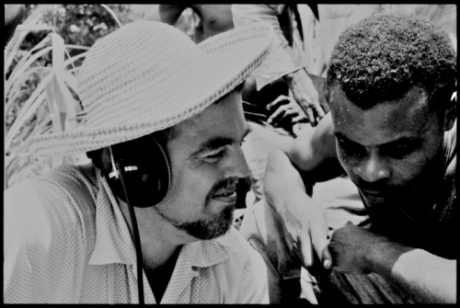
A huge treasure trove of songs and interviews recorded by the legendary folklorist Alan Lomax from the 1940s into the 1990s have been digitized and made available online for free listening.

The Association for Cultural Equity, a nonprofit organization founded by Lomax in the 1980s, has posted some 17,000 recordings.

“For the first time,” Cultural Equity Executive Director Don Fleming told NPR’s Joel Rose this week, “everything that we’ve digitized of Alan’s field recording trips are online, on our Web site. It’s every take, all the way through. False takes, interviews, music.”

It’s an amazing resource. For a quick taste, here are a few examples from one of the best-known areas of Lomax’s research, his recordings of traditional African American culture:
But that’s just scratching the surface of what’s inside the enormous archive. Lomax’s work extended far beyond the Deep South, into other areas and cultures of America, the Caribbean, Europe and Asia.

“He believed that all cultures should be looked at on an even playing field,” his daughter Anna Lomax Wood told NPR. “Not that they’re all alike. But they should be given the same dignity, or they had the same dignity and worth as any other.”

You can listen to Rose’s piece about the archive on the NPR website, as well as a 1990 interview with Lomax by Terry Gross of Fresh Air, which includes sample recordings from Woody Guthrie, Jelly Roll Morton, Lead Belly and Mississippi Fred McDowell.

To dive into the Lomax audio archive, you can search the vast collection by artist, date, genre, country and other categories, or go to the Sound Collections Guide for easy browsing.

h/t Judy Brophy and Matthew Barnes

Sunday, December 1, 2013

VIDEOS: Watch the Rolling Stones Write “Sympathy for the Devil”: A Highlight in Godard’s ’68 Film One Plus One

by , Open Culture: http://www.openculture.com/2013/11/godard-films-rolling-stones-writing-sympathy-for-the-devil.html

Josh Jones is a writer and musician based in Durham, NC. Follow him at @jdmagness


Naissance de "Sympathy for the devil " (one+one... by cinocheproduction

After the Rolling Stones’ partly misguided, partly inspired attempt at psychedelia, Their Satanic Majesties Request, the band found its footing again in the familiar territory of the Delta Blues.

But with the 1968 recording of Beggar’s Banquet, they also retained some of the previous album’s experimentation, taken in a more sinister direction on the infamous “Sympathy for the Devil.”

In the studio, with the band during those recording sessions, was none other than radical French New Wave director Jean-Luc Godard, who brought his own experimental sensibilities to a project he would call One Plus One, a document of the Stones’ late sixties incarnation - including an increasingly reclusive Brian Jones.

Godard punctuates the fascinating studio scenes of the Stones with what Andrew Hussey of The Guardian calls “a series of set pieces - an incoherent stew of Situationism and other Sixties stuff”:

Black Panthers in a disused car park execute white virgins; a bookseller reads aloud from Mein Kampf to Maoist hippies; in the final scene the bloodied corpse of a female urban guerrilla is raised to the Stones’ soundtrack as Godard himself darts about like a demented Jacques Tati waving Red and Black flags. You just don’t find this sort of thing at the local multiplex anymore.

For all of its heavy use of leftist Sixties iconography, its anarchic attempt to fuse “art, power and revolution,” and its fascinating portraiture of rock and roll genius at work, the film crash landed in France, earning the contempt of arch Situationist theorist Guy Debord, who called it “the work of cretins.”

Critics and audiences apparently expected more from Godard in the wake of the abortive May ‘68 student uprising in Paris, and the general neglect of the film meant that Godard missed his chance to, as he put it, “subvert, ruin and destroy all civilised values.”


The film’s producer, Iain Quarrier, also found it disappointing. Without the director’s permission, Quarrier decided to retitle One Plus One with the more commercially-minded Sympathy for the Devil and tack a completed version of that song to the last reel, a move that provoked Godard to punch Quarrier in the face.

But not everyone found Godard’s effort off-putting. In a 1970 review, the New York Times’ Roger Greenspun called it “heavily didactic, even instructional ... the prospective text of some ultimate, infinitely complex collectivism.” Greenspun also decried Quarrier’s unauthorized interventions.

In his retrospective take, Andrew Hussey admits that Godard’s political posturing is “bollocks,” but then concludes that One Plus One is “great stuff: a snapshot of a far-off, lost world where rock music is still a redemptive and revolutionary force.”

And it’s both - ridiculous and sublime, a powerful crystallization of a moment in time when all the Western world seemed poised to crack open and release something strange and new.

Watch Godard’s original film, One Plus One here (with Spanish subtitles); the trailer for the recast Quarrier version directly above; and the scenes where Godard captured the Stones’ giving birth to “Sympathy for the Devil” at the top.

It may be perfect viewing on “Black Friday,” that most absurd celebration of mindless consumerism.

Thursday, August 23, 2012

VIDEO: Bob Dylan and Allen Ginsberg Visit the Grave of Jack Kerouac (1979)

by Colin Marshall, Open Culture: http://www.openculture.com


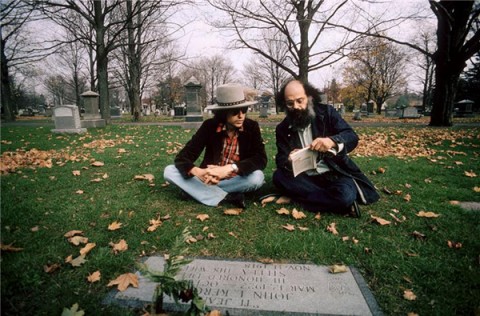
Above you can watch a rare 1979 meeting, of sorts, of three hugely influential twentieth-century cultural minds: Bob Dylan, Allen Ginsberg, and - in spirit, anyway - Jack Kerouac, who died ten years before.

This clip, though brief, would be fascinating enough by itself, but Sean Wilentz provides extensive backstory in “Penetrating Aether: The Beat Generation and Allen Ginsberg’s America,” an essay from the New Yorker.

“On a crisp scarlet-ocher November afternoon at Edson Cemetery in Lowell,” as he describes it, “Bob Dylan and Allen Ginsberg visited Kerouac’s grave, trailed by a reporter, a photographer, a film crew, and various others (including the young playwright Sam Shepard).”

There “Ginsberg recited not from Kerouac’s prose but from poetry out of Mexico City Blues [...] invoking specters, fatigue, mortality, Mexico, and John Steinbeck’s boxcar America, while he and Dylan contemplated Kerouac’s headstone.” Why that particular collection? “Someone handed me Mexico City Blues in St. Paul in 1959,” Wilentz quotes Dylan as having told Ginsberg. “It blew my mind.”

In the piece, which comes adapted from his book Bob Dylan in America, Wilentz goes into great detail describing Dylan as a link between two sometimes compatible and sometimes antagonistic subcultures in midcentury America: the folk music movement and the Beat generation.

“I came out of the wilderness and just naturally fell in with the Beat scene, the bohemian, Be Bop crowd, it was all pretty much connected,” Wilentz quotes Dylan as saying in 1985. “It was Jack Kerouac, Ginsberg, Corso, Ferlinghetti … I got in at the tail end of that and it was magic … it had just as big an impact on me as Elvis Presley.”

Wilentz describes Dylan relating to Kerouac as “a young man from a small declining industrial town who had come to New York as a cultural outsider more than twenty years earlier - an unknown bursting with ideas and whom the insiders proceeded either to lionize or to condemn, and, in any case, badly misconstrue.”


The Beats showed Dylan a path to maintaining his cultural relevance, a trick he’s managed over and over again in the decades since. “Even though Dylan invented himself within one current of musical populism that came out of the 1930s and 1940s,” Wilentz writes, “he escaped that current in the 1960s - without ever completely rejecting it - by embracing anew some of the spirit and imagery of the Beat generation’s entirely different rebellious disaffiliation and poetic transcendence.”

Note: Do you want to hear Sean Wilentz read Bob Dylan in America for free? (Find an audio sample here). Just head over to Audible.com and register for a 30-day free trial. You can download any audiobook for free. Then, when the trial is over, you can continue your Audible subscription, or cancel it, and still keep the audio book. The choice is entirely yours. And, in full disclosure, let me tell you that we have a nice arrangement with Audible. Whenever someone signs up for a free trial, it helps support Open Culture.

Related content:
‘The Ballad of the Skeletons’: Allen Ginsberg’s 1996 Collaboration with Philip Glass and Paul McCartney
Celebrate Jack Kerouac’s 90th Birthday with Kerouac, the Movie
Allen Ginsberg Reads His Classic Beat Poem, Howl
Colin Marshall hosts and produces Notebook on Cities and Culture. Follow him on Twitter at @colinmarshall.

Monday, August 20, 2012

VIDEO: The Jimi Hendrix Experience, Stockholm 1969

Hi all,

Here's some rare Hendrix footage - a complete concert from 1969 in Stockholm. I have no further information on the concert, so if anyone can enlighten us on this, it'd be great!
Jimi dedicated this performance to the American deserters.

Uploaded to YouTube by hobadoxa

Tuesday, August 14, 2012

VIDEO: Buffalo Springfield: "For What It's Worth"

Hi all,

This is one of the great anti-war pieces of the late 60s. This video is accompanied by a slide-show with clips of anti-Vietnam War protests and marches set to Buffalo Springfield's "For What It's Worth."


Uploaded by buttholesurferss

Wednesday, July 25, 2012

VIDEO: The Story of Abbie Hoffman

Hi Readers,

Here is a fascinating video about one of the most influential revolutionaries of the 1960s hippie movement - Abbie Hoffman. Enjoy!

Part 1


Part 2


Abbie Hoffman is featured in this 30 minute documentary that explores a firebrand of the 1960s. Abbie used humour and outrageousness in his pursuit of the American promise of equality and fairness.

Rabbi Norman Mendell said in his eulogy that Mr. Hoffman's long history of protest, antics though much of it had been, was 'in the Jewish prophetic tradition, which is to comfort the afflicted and afflict the comfortable.' Part 1 is 8 minutes long. Part 2 is 7 minutes long. Uploaded by avildsen1221 on Jan 21, 2009.

Thursday, July 19, 2012

VIDEOS: A History of Psychedelic Rock

Hey everyone,

Here's a terrific TV documentary on the History of Psychedelic Rock. It's in 7 parts on Youtube, although EMI has blocked Part 2. Anyway, I'm posting the other 6 episodes here. Below the videos is a great blurb about psychedelic rock. Enjoy!


Psychedelic rock is a style of rock music that attempts to replicate the mind-altering experiences of hallucinogenic drugs. It emerged during the mid 1960s among garage and folk rock bands in Britain and the United States.

Psychedelic rock is a bridge from early blues-based rock to progressive rock and heavy metal, but it also drew on non-Western sources such as Indian music's rāgas and sitars.

While the first contemporary musicians to be influenced by psychedelic drugs were in the jazz and folk scenes, the first use of the term "psychedelic" in popular music was by the "acid-folk" group The Holy Modal Rounders in 1964, with the song "Hesitation Blues."

The first use of the word "psychedelic" in a rock music context is usually credited to The Deep, and the earliest known appearance of this usage of the word in print is in the title of their 1966 album The Psychedelic Moods of the Deep. Roky Erickson, lead singer of The 13th Floor Elevators, coined the term 'psychedelic rock' in a 1966 interview.

In 1962, British rock embarked on a frenetic race of ideas that spread back to the U.S. with the British Invasion. The folk music scene also experimented with outside influences. In the tradition of Jazz and blues many musicians began to take drugs, and include drug references in their songs.

Beat Generation writers like William Burroughs, Jack Kerouac, Allen Ginsberg and especially the new exponents of consciousness expansion such as Timothy Leary, Alan Watts and Aldous Huxley profoundly influenced the thinking of the new generation.

In late 1965, The Beatles unveiled their brand of psychedelia on the Rubber Soul album, which featured John Lennon's first paean to universal love ("The Word") and a sitar-laden tale of attempted hippy hedonism ("Norwegian Wood", written by John Lennon).

The British rock act The Yardbirds recorded the single "Happenings Ten Years Time Ago" in 1966, another track frequently cited as the first psychedelic song, this one due to its frantic evocation of drug-induced paranoia.

Psychedelia began in the United States' folk scene with New York City's Holy Modal Rounders introducing the term in 1964. A similar band called Mother McCree's Uptown Jug Champions from San Francisco were influenced by The Byrds and the Beatles to switch from acoustic music to electric music in 1965.

Renaming themselves the Warlocks, they fell in with Ken Kesey's LSD-fueled Merry Pranksters in November 1965, and changed their name to the Grateful Dead the following month. The Dead played to light shows at the Pranksters' "Acid Tests", with pulsing images being projected over the group in what became a widespread practice.

Thursday, May 3, 2012

Jimi Hendrix, Live in Stockholm, 1969

Hi everyone, Here's a rare video of the Jimi Hendrix Experience performing live in Stockholm in 1969. He dedicated the concert to the Vietnam War deserters. Enjoy!

Saturday, February 18, 2012

The Dick Cavett Show from 1969 with Jefferson Airplane, David Crosby and Stephen Stills, and Joni Mitchell

by Colbuckshot on YouTube: http://www.youtube.com/user/colbuckshot

The Dick Cavett Show - August 19, 1969 - The Dick Cavett Show from 1969 with Jefferson Airplane, David Crosby and Stephen Stills, and Joni Mitchell.


Saturday, January 21, 2012

VIDEO(S): History of Psychedelic Rock

Hey everyone,

Here's a terrific TV documentary on the History of Psychedelic Rock. It's in 7 parts on Youtube, so I'm posting all 7 episodes here. Below the videos is a great blurb about psychedelic rock. Enjoy!


Psychedelic rock is a style of rock music that attempts to replicate the mind-altering experiences of hallucinogenic drugs. It emerged during the mid 1960s among garage and folk rock bands in Britain and the United States.

Psychedelic rock is a bridge from early blues-based rock to progressive rock and heavy metal, but it also drew on non-Western sources such as Indian music's rāgas and sitars.

While the first contemporary musicians to be influenced by psychedelic drugs were in the jazz and folk scenes, the first use of the term "psychedelic" in popular music was by the "acid-folk" group The Holy Modal Rounders in 1964, with the song "Hesitation Blues."

The first use of the word "psychedelic" in a rock music context is usually credited to The Deep, and the earliest known appearance of this usage of the word in print is in the title of their 1966 album The Psychedelic Moods of the Deep. Roky Erickson, lead singer of The 13th Floor Elevators, coined the term 'psychedelic rock' in a 1966 interview.

In 1962, British rock embarked on a frenetic race of ideas that spread back to the U.S. with the British Invasion. The folk music scene also experimented with outside influences. In the tradition of Jazz and blues many musicians began to take drugs, and include drug references in their songs.

Beat Generation writers like William Burroughs, Jack Kerouac, Allen Ginsberg and especially the new exponents of consciousness expansion such as Timothy Leary, Alan Watts and Aldous Huxley profoundly influenced the thinking of the new generation.

In late 1965, The Beatles unveiled their brand of psychedelia on the Rubber Soul album, which featured John Lennon's first paean to universal love ("The Word") and a sitar-laden tale of attempted hippy hedonism ("Norwegian Wood", written by John Lennon).

The British rock act The Yardbirds recorded the single "Happenings Ten Years Time Ago" in 1966, another track frequently cited as the first psychedelic song, this one due to its frantic evocation of drug-induced paranoia.

Psychedelia began in the United States' folk scene with New York City's Holy Modal Rounders introducing the term in 1964. A similar band called Mother McCree's Uptown Jug Champions from San Francisco were influenced by The Byrds and the Beatles to switch from acoustic music to electric music in 1965.

Renaming themselves the Warlocks, they fell in with Ken Kesey's LSD-fueled Merry Pranksters in November 1965, and changed their name to the Grateful Dead the following month. The Dead played to light shows at the Pranksters' "Acid Tests", with pulsing images being projected over the group in what became a widespread practice.

Saturday, January 14, 2012

Dr. Martin Luther King Jr. - Man of Peace In a Time of War

Hi everyone,

Here is a fascinating documentary, which has remained unseen for 40 years, about the life of Martin Luther King, Jr. This is fascinating and I hope you enjoy it. I have posted it as it is a significant lead-in to the culture of the 1960s.

SYNOPSIS: Dr. Martin Luther King Jr. - Man of Peace In a Time of War

A rare and candid TV interview with Martin Luther King, Jr. - unseen in 40 years - is the centerpiece of this timely tribute, featuring exclusive interviews with such notables as Jesse Jackson and Colin Powell that provide fresh insight into the life and personality of the late civil rights leader.


Film Credits

Executive Producer: Dante J. Pugliese
Produced by Steve Stoliar
Narrated by Obba Babatunde
Written by Henry Stephens
Edited by Kent Hagen
Art Director: Daryl Bailey
Enhanced by Zemanta