Showing posts with label Interviews. Show all posts

Friday, February 17, 2017

INTERVIEW: The Real Story Behind Jethro Tull's 'Aqualung'

by Joe Bosso, Music Aficionado: https://web.musicaficionado.com/main.html?utm_source=email&utm_campaign=WeeklyRecommendations#!/article/the_real_story_behind_jethro_tull_aqualung_by_joebosso

Photo Courtesy of Getty Images
Jethro Tull had already hit the top spot on the U.K. charts with their 1969 release, Stand Up, but success in America was a harder nut to crack.

Their third album, 1970's Benefit, came this-close to the U.S. Top 10, but stopped one mark short, landing at No. 11. It wasn't until the band issued their landmark album Aqualung in 1971 that the doors to mainstream acceptance flung open in a big way, with the record going all the way to No. 7.

The album, a deft mix of pastoral folk-rock, thundering proto-metal and nascent prog, is generally regarded as Jethro Tull's undisputed masterpiece. But as Ian Anderson tells Music Aficionado, he wasn't initially sure that the record's broad blend of styles was a slam-dunk.

"We were getting quite esoteric on the album, and I felt that we might have pushed things too far in that regard," he says.

"What gets you noticed in one territory might not have the same appeal elsewhere. The record had a lot of more acoustic singer-songwriter material on it, and Jethro Tull had become thought of as more of a rock band. The riffy rock material had a pretty immediate appeal to live audiences, so I felt reasonably confident and gratified. But you never know until you put it out, and then the record did very well, so it all worked."

Many fans have called 'Aqualung' a concept album, but you've always maintained that it isn't anything of the sort.

It was never a concept album in my eyes. Yes, it certainly set out with the idea that there would be a few songs that kind of hung together, but there were a whole bunch of songs that didn't have anything to do with the others. When it came to the artwork for the album cover, which I rather left in terms of the pictorial images to our then manager, Terry Ellis, I thought that that would be best illustrated in terms of text by trying to give it some sense of order, by making it hang together a little bit more as a package. I guess that's what made people think it was a concept album.

I've always felt it a little difficult to deal with in response to the allegations that it was a concept album. As I said, it wasn't. There were just a few songs as I say that were in a similar vein and on a general topic of, I suppose, religion and growing up, and I still to this day would not call it a concept album by any means. Of course, speaking to the concept album question, I said, "I'm going to get my comeuppance next time around," and we did with Thick as a Brick, something quite surreal and preposterous - and we got away with it [Laughs].

As you mentioned, 'Aqualung' has some incredible riffs, like the title track, Hymn 43, Cross-Eyed Mary and Locomotive Breath. What was your process for writing them?

Oh, just sitting with a guitar in a Holiday Inn or somewhere on tour, and hoping that I came up with something. I was probably sharing rooms with [bassist] Glenn Cornick at that point - we weren't able to afford separate rooms then. Luckily, Glenn was a party guy, so he liked to go out a lot and meet people and do things, and I could sit in the room if it was a day off and try to come up with some tunes. But they all began very much on the acoustic guitar, and then you try to imagine taking them into the world of large-scale rock rather than hearing them as singer-songwriter acoustic-y things.

You've talked about being influenced by people like Roy Harper and Bert Jansch. Were those guys in your mind when you wrote the acoustic-oriented tracks?

Yes, there was certainly an influence from both of those people. I knew Roy Harper a bit. We'd done some shows together and appeared, I think, at the very first concert in Hyde Park. It was Jethro Tull, T.Rex, and, I think, Pink Floyd and Roy Harper. The previous year I'd met Bert Jansch, and I think we saw Pentangle play somewhere in Boston when they were staying in the same Holiday Inn as we were. I was aware of those guys, and some of them I liked and some of them I didn't, but the other thing was that I was never at that point really into any of the equivalent singer/songwriter, acoustic guitar type act in the U.S.

Simon and Garfunkel just passed me by, and even when I first heard Bob Dylan, he rather grated on my ear. I found his very Americana-Midwest kind of lyric and singing style rather … it didn't appeal to me. Later on I appreciated what an important artist he is, of course. But the English artists who were in that vein, who drew upon some of the more original English kind of themes or traditional English and Scottish and Irish folk music, I don't think they were ever as successful as were those two or three American artists who did big things with an acoustic guitar and carefully thought-out voices.

This was the first album with keyboardist John Evan as a full-time member, the first with bassist Jeffrey Hammond, and it was the last album with drummer Clive Bunker. What was the general mood in the studio?

It was a rather dark mood, actually, and it was a bit frustrating for me because the recording was being done in the then new Basing Street Studios, which was a converted church that Island Records had bought and turned into a pair of studios. Led Zeppelin were working in the smaller studio downstairs, which is a much nicer acoustic room - much cozier and more like a proper recording studio. Upstairs it was the big, cavernous church hall, which had a rather spooky and threatening atmosphere. It was quite difficult acoustically and technically - there were problems and shakedown issues with the equipment and wiring. It was a real struggle.

All of which makes it more difficult when you're trying to convey to other musicians what you're driving at. We had stepped away from the early Jethro Tull sort of music, and Clive Bunker found it sometimes beyond his points of reference. For Jeffrey Hammond, it was his very first album, so he was kind of just being given a list of notes and told how to play them. I was confident he would get it, but it was a little nerve-racking for him. Here, too, it was a little frustrating for me, trying to convey things to the other guys, which is why I just recorded some things on my own and then they came and overdubbed their bits afterwards.

"Locomotive Breath" was a particularly hard song to record because we just couldn't get a metronomic, solid feel. It just kept being kind of a bit scrappy and whatever, so I went out and played tambourine or something, or maybe I clicked two drumsticks together or something. I played bass drum and hi-hat all the way through the song, and everybody overdubbed their parts to that. I think I played one of the electric guitar parts as well, just to try and get something that would convey the feel of the song to the other guys. Then John went out and recorded the introduction part, which we edited onto the body of the song. But yeah, it wasn't a great atmosphere. By the end of it, I was quite relieved to get out of there.

You mentioned the religious theme to some of the songs. Did you ever get any flack from the Bible Belt in the States?

Yes, but that was the only place. It just happened a little bit in America where we got some fairly negative stuff and people were burning the album. But I also got from the U.S.A., as I did elsewhere, a lot of very positive and supportive comments from members of the clergy, from priests who understood what I was saying and why I was saying it, and who felt some empathy for the essential criticism of organized religion and the essence of not turning religion into a sort of power game for those in charge.

When writing lyrics, did you ever edit yourself at all? I remember the line in "Hymn 43" - "Jesus saves, well, He'd better save Himself." That's a strong line.

Yes, there were strong lines in "Hymn 43" and My God, some fairly strong sentiments, and I can understand people getting a bit bent out of shape. But back then we were all empowered with a kind of rather mouthy, Trumpish tone, and it was expected that you could get away with it, whereas I think today in a more politically correct world, while Mr. Trump himself would appear to get away with it at least half of the American public, most other people are absolutely appalled by it.

Sometimes to shock is a valid approach in the arts. I'm much more nervous about causing offense today than I was back then. Strangely, the place where I never really got any flack was in Italy, in the heart of Catholicism. The Italians loved those songs. I think in Spain we had a little bit of an issue for one particular line - "Got him by the balls," in "Locomotive Breath." They weren't too comfortable with that one.

When you were working on the record, did members of Zeppelin ever drop by? Did you pop into their sessions at all?

I think I might have popped my head downstairs. Some people quite like it when they get visitors, and they rather enjoy the camaraderie, but I felt like it would be very intrusive to go in while somebody else is doing a session, whether they're working on a backing track or doing overdubs or whatever.

Once or twice we did manage to get some work done in the studio downstairs when Zeppelin weren't in. The only time I remember seeing anybody from that band is when Jimmy Page came in when Martin Barre was recording the guitar solo for "Aqualung," and Jimmy sort of was standing behind me in the control room and waving some support to Martin. Maybe that enthusiasm imparted itself to Martin's playing on that recorded take.

What did you think of Iron Maiden's cover of "Cross-Eyed Mary"?

Oh, it was a very spirited rendition. I didn't hear it until much later on - I think they did it early on in their career, when Bruce Dickinson was probably quite new in the band. He, like some of the other guys, grew up in their early performing years listening to Jethro Tull, so I guess it was one of those cover pieces they might have played on stage. They did a high-energy version of it, and Bruce, as he does, went for the full-on high notes and big vocals and that I can't do. It was entertaining hearing them do a high-octane version of it.

'Aqualung' has gone on to be the band's biggest seller. Are you OK with that, or do you wish that distinction were for a different record?

Well, I'm glad it was that album and not some other ones. It was at a time when there was kind of a maturity coming about in terms of my writing and my understanding of music, so for me it was a very important album. It marked my move towards a more dynamic range in music, my understanding of creating more tension between loud and quiet passages, between simple and more complex pieces.

Indeed, those are things I probably learned the year before from being on tour and playing a number of shows with Led Zeppelin. Jimmy Page got all that figured out, so there were good lessons to learn from him as a writer, arranger and record producer, how the dynamics of rock music could be so exciting.

But yeah, I'm very happy how successful 'Aqualung' has been. It wasn't a huge hit out of the box, but it was a steady seller over the years, and that continues to this day. It's clocked up a lot of mileage, which has put it in that sort of top echelon of rock albums from that era. I'm quite happy with how it's regarded.

Thursday, December 5, 2013

VIDEO: Rock and Roll: An American Story - Music Resources for Teachers!

by RetroKimmer: http://www.retrokimmer.com/2013/12/rock-and-roll-american-story-music.html


Rock and Roll: An American Story (RRAS) is an online educational resource presented by Steven Van Zandt's Rock and Roll Forever Foundation and offered free-of-charge to educators and individuals everywhere.


Interdisciplinary in nature, RRAS is geared toward middle and high school students but includes resources for learning at all levels. Launched in Fall 2013, the website offers new lesson plans and teaching resources on a monthly basis.

Educators are encouraged to create user accounts, which will allow them to receive notifications when new content is made available. This is where the story will unfold!

 Steven Van Zandt


FOUNDATION & TEAM

Steven Van Zandt founded the Rock and Roll Forever Foundation in response to a drop-out crisis he saw crippling American education. Believing that student engagement is a significant facet of the crisis, he conceived a curriculum based around popular music, a subject that connects with student interest and passion.

Importantly, what he then created with his team is a curriculum that is not restricted to music departments alone, a truly interdisciplinary curriculum.

Now endorsed by the National Council for the Social Studies and the National Association for Music Education, with partners including Scholastic Inc., Reelin' in the Years, ABC News, Rock's Backpages, New York University's Steinhardt School, and the Grammy Museum, Van Zandt's Rock and Roll Forever Foundation is launching Rock and Roll: An American Story.


 EXECUTIVE DIRECTOR
Dr. Warren Zanes


FOUNDER'S BOARD
Jackson Browne
Martin Scorsese
Bono
Bruce Springsteen
Steven Van Zandt, Chair

Wednesday, December 4, 2013

The Alan Lomax Sound Archive Now Online: Features 17,000 Recordings

by , Open Culture: http://www.openculture.com/2012/03/the_alan_lomax_music_archive_now_online.html


A huge treasure trove of songs and interviews recorded by the legendary folklorist Alan Lomax from the 1940s into the 1990s have been digitized and made available online for free listening.

The Association for Cultural Equity, a nonprofit organization founded by Lomax in the 1980s, has posted some 17,000 recordings.

“For the first time,” Cultural Equity Executive Director Don Fleming told NPR’s Joel Rose this week, “everything that we’ve digitized of Alan’s field recording trips are online, on our Web site. It’s every take, all the way through. False takes, interviews, music.”

It’s an amazing resource. For a quick taste, here are a few examples from one of the best-known areas of Lomax’s research, his recordings of traditional African American culture:
But that’s just scratching the surface of what’s inside the enormous archive. Lomax’s work extended far beyond the Deep South, into other areas and cultures of America, the Caribbean, Europe and Asia.

“He believed that all cultures should be looked at on an even playing field,” his daughter Anna Lomax Wood told NPR. “Not that they’re all alike. But they should be given the same dignity, or they had the same dignity and worth as any other.”

You can listen to Rose’s piece about the archive on the NPR website, as well as a 1990 interview with Lomax by Terry Gross of Fresh Air, which includes sample recordings from Woody Guthrie, Jelly Roll Morton, Lead Belly and Mississippi Fred McDowell.

To dive into the Lomax audio archive, you can search the vast collection by artist, date, genre, country and other categories, or go to the Sound Collections Guide for easy browsing.

h/t Judy Brophy and Matthew Barnes

Wednesday, November 20, 2013

VIDEO: Discovered: Conversation with John Lennon, Yoko Ono, and Timothy Leary at Montreal Bed-In (1969)

by , Open Culture: http://www.openculture.com/2012/06/john_lennon_yoko_ono_and_timothy_leary_1969.html

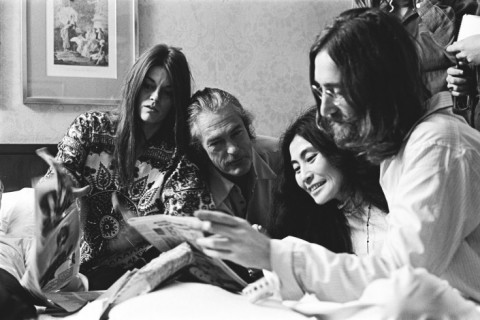
On May 26, 1969, John Lennon and Yoko One began their second “Bed-In,” a form of anti-Vietnam War protest that combined the media impact of a press conference with the comfort of hotel sheets.


Their first Bed-In, which happened in various rooms of the Amsterdam Hilton in late March of that year, saw them grant interview after interview about peace all day long without moving from the bed in which they had ensconced themselves.

They’d scheduled its follow up in New York City, but Lennon found he couldn’t enter the United States due to a previous conviction for marijuana possession.

They relocated it to the Bahamas, where the heat soon prompted them to move again to the entirely cooler Queen Elizabeth Hotel in Montreal.

There they recorded the song “Give Peace a Chance,” aided by such visitors as Tommy Smothers, Dick Gregory, Murray the K, and psychedelic drug advocate Timothy Leary.

But Leary didn’t just come to provide a backing vocal. With his wife Rosemary, he recorded a conversation with Lennon and Ono about … well, about a variety of subjects, but they’d all fall under the broad heading of Leary’s one great pursuit, “consciousness.”

Only recently did Leary archivist Michael Horowitz discover the transcript of this session in “an unmarked envelope in a box of miscellaneous papers,” and this week the Timothy Leary Archives made it available to the public for the first time ever.

The conversation begins with the finer points of teepee life, moves on to the effects of place on one’s state of mind, touches on both couples’ having found themselves on the wrong side of drug law enforcement, and ends with Lennon and Leary comparing notes on how they use the media to convey their message:
TIMOTHY: John, about the use of the mass media ... the kids must be taught how to use the media. People used to say to me - I would give a rap and someone would get up and say, “Well, what’s this about a religion? Did the Buddha use drugs? Did the Buddha go on television? I’d say, “Ahh - he would’ve. He would’ve …”.
JOHN: I was on a TV show with David Frost and Yehudi Menuhin, some cultural violinist y’know, they were really attacking me. They had a whole audience and everything. It was after we got back from Amsterdam … and Yehudi Menuhin came out, he’s always doing these Hindu numbers. All that pious bit, and his school for violinists, and all that. And Yehudi Menuhi said, “Well, don’t you think it’s necessary to kill some people some times?” That’s what he said on TV, that’s the first thing he’s ever said. And I said, “Did Christ say that? Are you a Christian?” “Yeah,” I said, and did “Christ say anything about killing people?” And he said, “Did Christ say anything about television? Or guitars?”
To learn more about Lennon and Ono’s Bed-Ins, you can visit the 70-minute documentary Bed Peace (below), previously featured on Open Culture and still freely viewable on YouTube:

Saturday, September 29, 2012

INTERVIEW: Bob Dylan Strikes Back at Critics: Addresses Plagiarism Charges For the First Time in New Rolling Stone Interview

by Rolling Stone, http://www.rollingstone.com/music/news/bob-dylan-strikes-back-at-critics-20120912

bob dylan cover 1166
Bob Dylan on the Cover of Rolling Stone (Sam Jones)
Bob Dylan opens up like never before in the new issue of Rolling Stone, on newsstands Friday, September 14th.

In the interview with Mikal Gilmore, Dylan covers an incredible range of topics: John Lennon and Bruce Springsteen; what he really thought about the movies I'm Not There and Masked and Anonymous; being picked up by the police in New Jersey in 2009; and - in a remarkable stretch - his belief that he was "transfigured" around the time of his 1966 motorcycle accident.

Dylan also, for the first time, strikes back at critics who have accused him of drawing too much from the work of others. Here's an excerpt:

I want to ask about the controversy over your quotations in your songs from the works of other writers, such as Japanese author Junichi Saga's Confessions of a Yakuza, and the Civil War poetry of Henry Timrod. In folk and jazz, quotation is a rich and enriching tradition, but some critics say that you didn't cite your sources clearly. What's your response to those kinds of charges?

Oh, yeah, in folk and jazz, quotation is a rich and enriching tradition. That certainly is true. It's true for everybody, but me. There are different rules for me. And as far as Henry Timrod is concerned, have you even heard of him? Who's been reading him lately? And who's pushed him to the forefront? Who's been making you read him? And ask his descendants what they think of the hoopla. And if you think it's so easy to quote him and it can help your work, do it yourself and see how far you can get.

Wussies and pussies complain about that stuff. It's an old thing - it's part of the tradition. It goes way back. These are the same people that tried to pin the name Judas on me. Judas, the most hated name in human history!

If you think you've been called a bad name, try to work your way out from under that. Yeah, and for what? For playing an electric guitar? As if that is in some kind of way equitable to betraying our Lord and delivering him up to be crucified. All those evil motherfuckers can rot in hell. 

Seriously?  

I'm working within my art form. It's that simple. I work within the rules and limitations of it. There are authoritarian figures that can explain that kind of art form better to you than I can. It's called songwriting. It has to do with melody and rhythm, and then after that, anything goes. You make everything yours. We all do it.

For the full interview, pick up the new issue of Rolling Stone.

Monday, September 24, 2012

INTERVIEW: Neil Young Comes Clean

by David Carr, The New York Times: http://www.nytimes.com/2012/09/23/magazine/neil-young-comes-clean.html?src=me&ref=general&pagewanted=all&_r=0

 
“I can still remember how it smelled when I first pulled in here - I was driving this car,” he said, recalling the trip in 1970 when he bought the place and named it Broken Arrow, after the Buffalo Springfield song.

The author of some of the spookiest, darkest songs in the American folk canon seemed jolly on this late-August day. Even if he was accompanied by a reporter, generally not his favorite species of human, the motion soothed him. “I’ve always been better moving than I am standing still,” he said.

Young, 66, spotted this land out the window of a plane banking out of San Francisco four decades ago and now owns nearly 1,000 acres of it. His song “Old Man” is a tribute to the caretaker who first showed him the place.

“I ran out of money, so I had to sell some of it,” he said. “That’s O.K., because it was too big. Everything happens for a reason.” He kept his eyes on the narrow road through the giant redwoods.

It was hard to reconcile the affable guy motoring along on a sunny day with his past incarnations: the portentous folkie of “Ohio,” the rabid anti-commercialist who gave MTV the musical middle finger with “This Note’s For You,” the angry rocker who threatened to hit the cameramen at Woodstock with his guitar. He was happy partly because he was here.

“For whatever you’re doing, for your creative juices, your geography’s got a hell of a lot to do with it,” he said. “You really have to be in a good place, and then you have to be either on your way there or on your way from there.”

We would spend a few hours creeping along - he drove slowly but joyfully, as if the automobile were a recent invention - on our way there or on our way from there, the ranch where Young lives with his wife, Pegi, and their son, Ben. His longtime producer and friend, David Briggs, who died in 1995, hated making records here, deriding the hermetic refuge as a “velvet cage.”

In addition to the studio, where more than 20 records have been made, there is an entire building given over to model trains, another where vintage cars are stored and another piled with his master recordings. Llamas and cows roam under cartoonishly large trees. It seems like a made-up place, an open-air fortress of eccentricity meant to protect the artist who lives there. But what it has most of all is not a lot of people.

“I like people, I just don’t have to see them all the time,” he said, laughing. David Crosby, his bandmate in Crosby, Stills, Nash & Young, used to describe the complicated route into his ranch as “my filtering system,” Young said.

He made a bunch of rights and lefts through the forest before getting out to unlock the gate. Others might have an electronic gate, but Young likes the mechanical experience of slipping a key into a padlock and swinging something open. He is fundamentally analog, despite the occasional electronic excesses in his music. He likes amps with knobs that go to 12 and things that click when you touch them.

I made it past the filtering system because Young was promoting his autobiography, “Waging Heavy Peace,” which comes out next week. The book is elliptical and personal, with little of the period poetics of “Just Kids,” by Patti Smith, or the scabrous detail of “Life,’’ by Keith Richards.

Young once promised he would never write a book about himself, according to Jimmy McDonough’s biography of him, “Shakey.” But time passed, and then Young broke his toe a year ago and needed something to fill his time and refresh his fortune.

“I don’t think I’m going to be able to continue to mainly be a musician forever, because physically I think it’s going to take its toll on me - it’s already starting to show up here and there,” he said. Writing a book, he added, allowed him “to do what I want the way I want to do it.”

“Waging Heavy Peace” eschews chronology and skips the score-settling and titillation of other rocker biographies. Still, Young shows a little leg and has some laughs. Yes, he partied with Charles Manson and tried to hook him up with a recording contract.

He admits he saw a picture of the actor Carrie Snodgress in a magazine before he courted her, married her and divorced her. He pleads guilty to having been busted for drugs with Eric Clapton and Stephen Stills. He even has a little fun with Crosby.

“I still remember ‘the mighty Cros’ visiting the ranch in his van,” he writes. “That van was a rolling laboratory that made Jack Casady’s briefcase look like chicken feed. Forget I said that! Was my mike on?”

But as the book progresses, the operatics of the rock life give way to signal family events, deconstructions of his musical partnerships and musings on the natural world. It is less a chronicle than a journal of self-appraisal.

The book, like today’s drive, is a ride through Young’s many obsessions, including model trains, cars like the one we were touring in and Pono, a proprietary digital musical system that can play full master recordings and will, he hopes, restore some of the denuded sonic quality to modern music.

Although he rarely meets the press, mostly out of lack of interest, there is no reluctance on this occasion. A plain-spoken Canadian from the tiny town of Omemee, Ontario, and a son who has done the work of his father - Scott Young, a Canadian journalist, wrote more than 30 books - he wants to be understood.

Every question is mulled and answered directly, without ornamentation. But each time when I guessed which way we were turning, on the road or in conversation, he almost always went the other way. “Too many decisions to make with no sign of what to do,” he said, laughing as he steered around a hairpin onto a side road.

Young has routinely fled success, severed profitable musical partnerships, dumped finished records and withdrawn when it was precisely the moment to cash in. He is a person who will never leave well enough alone. “Sometimes a smooth process heralds the approach of atrophy or death,” he writes in “Waging Heavy Peace.”

Doing as he pleases has worked out pretty well for him. As a young musician torn between the crunch of the Rolling Stones and the lyricism of Bob Dylan, he avoided the fork altogether and forged his own path.

Over the course of more than 40 records and hundreds of performances that date to the mid-’60s, he has backed Rick James, jammed with Willie Nelson, dressed up with Devo, rocked with Pearl Jam and traded licks with Dylan. Some of it has been terrible, much of it remarkable. He has made movies by himself and with Jim Jarmusch and Jonathan Demme.

He called out Richard Nixon, praised Ronald Reagan and made fun of the second Bush. And he has little interest in how all of that was received. “I didn’t care and still don’t,” he said, then went on: “I experimented, I tried things, I learned things, I know more about all of that than I did before.”

His longtime manager and friend Elliot Roberts describes Young as “always willing to roll the dice and lose” and says: “He has no problem with failure as long as he is doing work he is happy with. Whether it ends up as a win or loss on a consumer level is not as much of an interest to him as one might think.”

His records don’t sell as much as they used to, but while many of his contemporaries are wanly aping their past, Young takes to the stage surrounded by mystery and expectation.

And now he’s doing so again on tour with Crazy Horse, a thunderous, messy concoction of a band that has backed him over the years and been a source of constancy amid all the hard turns in his career. “We’ve got two new albums, so we’re not an oldies act, and we’re relevant because we’re playing these new songs, so that gives us something to stand on,” he said.

It’s safe to predict that people will come, critics will rave and a 66-year-old man afflicted with epilepsy and serious back problems (and who has had polio and suffered an aneurysm) will rock hard enough to become a time machine back to when music was ecstatic and ill considered.

Dylan, in a note his manager passed to me, says it’s clear why Young has not tumbled into musical dotage: “An artist like Neil always has the upper hand,” he says. “It’s the pop world that has to make adjustments. All the conventions of the pop world are only temporary and carry no weight. It’s basically two different things that have nothing to do with each other.”

“Waging Heavy Peace” faithfully catalogs the disappointment Young has produced in those around him, but he expresses little regret today. “I work for the muse,” he said. When he swerved into techno and country after Geffen Records signed him in the early ’80s, Young was accused of making “unrepresentative” music.

He responded by taking a pay cut of half a million dollars for each of his next three albums. “I’m not here to sell things. That’s what other people do, I’m creating them. If it doesn’t work out, I’m sorry; I’m just doing what I do. You hired me to do what I do, not what you do. As long as people don’t tell me what to do, there will be no problem.”

Two nights before, at the Outside Lands festival in Golden Gate Park in San Francisco, Young headlined with Crazy Horse, their sixth performance this year after going the better part of a decade without playing together.

Beck went on before them and covered “After the Gold Rush,” and Foo Fighters followed, with Dave Grohl mentioning that the sooner he got done, the sooner they’d all get to hear Young play (he stood at the side of the stage afterward for Young’s entire set).

The youthful festival crowd wore little more than tattoos on this damp summer night. Young and Crazy Horse took the stage looking like the Friday-night band at the local V.F.W.: big shirts, work boots and hair gone gray or just gone. Given the growing chill and a restless crowd, it would have made sense to begin with a song reminding the audience that a Big Deal Rock Star was at work.

Instead, the band kicked into “Love and Only Love,” a remarkable song from Young’s 1990 album with Crazy Horse, “Ragged Glory,” but hardly a singalong. It lasted 14 minutes, with Young shredding huge reams of noise and mixing it up with his fellow guitarist Frank (Poncho) Sampedro.

Seeing them play was like watching an ancient steam shovel unfurl, claw the night air and dig in. “We thought it was important to introduce ourselves, to remind people what Crazy Horse is all about,” Sampedro said later.

Young, who has never been a graceful stage presence, lurched to the front. He is old - he began playing in this town more than 40 years ago - and bent over his guitar, but he is not old and bent. Young has never been physically whole, but that brokenness has annealed rather than slowed him. He is anything but a frail man when he has a guitar in his hand.

His musical ideas work, whether plugged into a stack of amps or plucked on an acoustic guitar. As his solo career veered from unadorned folk into multiple genres, critics scratched their heads and fans felt whipsawed.

But the “Rust Never Sleeps” tour in 1978 was bifurcated into acoustic and electric sets, a set of tracks he still switches between, which, along with his refusal to license his music for ads, has made him an emblem of authenticity for the next generation, the keeper of rock’s soul. And after all his side trips, he always came back to Crazy Horse, as he had tonight.

Derided by more sophisticated players over the years, Crazy Horse is as much an ethos as a band. As Young says in his book: “The songs the Horse likes to consume are always heartfelt and do not need to have anything fancy associated with them. The Horse is very suspicious of tricks.”

The band’s music with Young is built around a long-running sibling argument between Young and Old Black, his painted-over Gibson Les Paul guitar. Young, born in 1945, is the older brother to Old Black, made in 1952.

Through the years, Old Black has been souped up, tweaked and rebuilt, but it has never been replaced as his musical partner. When he plays it, he often looks and sounds furious (in explaining the equanimity that characterizes his book, he writes: “Sometimes it’s better not to blow up at someone. I can save that anger and emotion for my guitar playing”).

Young can plink out a song on a piano, and play harmonica when it serves, but he has an intimate, if savage, relationship with his guitars. “If you wanna write a song, ask a guitar,” he said to Patti Smith onstage at a book convention earlier this year to promote “Waging Heavy Peace.”

He played that night as if he were mad at Old Black, even if he smiled into the squall. The crowd remained enthralled as he tortured a single note with the whammy bar, although this kind of indulgence has worn out some of his other playing partners. “We’ve played that note, can we move on, Neil?” Stephen Stills says with a laugh over the phone as he recalls playing with Young.

The guitar owned the night, but the secret to Young’s durability is his voice, a nasal-inflected borderline whine that was never a luxurious instrument, but remains intact. He sounded as he always did, yelling the chorus to “Powderfinger” or plaintively singing “The Needle and the Damage Done.”

Jonathan Demme, who has made three concert films with Young, including “Neil Young Journeys,” which came out in the summer, finds Young’s playing and visage “irresistibly cinematic.” “I saw Neil after a show and told him how amazing it was, and he said: ‘Well, it better be amazing. Those people out there paid a lot of money to be here.’ ”

Part of the reason they pay to see Young in concert is that he respects the form. And they show up expecting the unexpected.

“You never know what you are going to get in a Neil Young concert because he never knows exactly what he is going to do,” says Willie Nelson, a friend who started Farm Aid with Young and John Mellencamp in 1985. “That way everyone is surprised.”

Tonight, he was feeling playful, telling the crowd, “I wrote this one this morning,” before starting into “Cinnamon Girl,” one of a trilogy of songs, which also includes “Cowgirl in the Sand” and “Down by the River,” that he wrote in a single-day fever back in 1968.

Later, he stepped to the mike and introduced a new song by saying: “We can’t help ourselves, we’re trained like chimps. They trained us to write songs, and we don’t know how to stop.”

The fourth song of the night was “Walk Like a Giant,” from the forthcoming album with Crazy Horse, “Psychedelic Pill”:

I used to walk like a giant on the land
Now I feel like a leaf floating in a stream
I want to walk like a giant.

The song ended with a solid four minutes of a repeating, thudding note as the band stomped in big steps, dinosaurs in full frolic. Boom. Boom. Boom. The audience tried clapping but finally gave up until the amps died down. It sounded like a hair-metal parody, but in Young’s hands it had the aura of ceremony.

While Young played, I stood stage right with his son Ben, a quadriplegic with cerebral palsy who is unable to speak. When he was born, Young and his wife, Pegi, a singer and musician, put everything else aside to help him develop his motor skills.

Now 34, Ben goes on every tour. “He’s our spiritual leader in that way,” Young says. “We take him everywhere, and he’s like a measuring stick for what’s going on” (Zeke, Young’s son by Snodgress, has a very mild case of cerebral palsy and works at Home Depot. Young’s daughter, Amber, is a talented young artist who works in San Francisco).

Ben Young, which is how his father often refers to him, was bundled against the chill and surrounded by friends. He looked over at me at one point, and I found myself wishing I knew what he thought about the proceedings. “I tell Ben everything, and he listens,” Young would tell me later. “He knows everything, but who is he going to tell?”

Sitting with Young in his bus after the show as he ate a salad and drank lemonade - he’s been sober for a year, the first time in decades that he has worked without drinking or smoking pot - it felt as if we were inside a guitar, the bus’s rococo interior constructed out of layers of redwood sheets, built exactly to Young’s taste.

Money doesn’t seem to matter much to Young unless he is out of it, but things matter plenty. With assorted companions, he builds and tweaks guitars, cars, buses and trains.

Sampedro, along with the drummer Ralph Molina and the bassist Billy Talbot, passed through, all of them clearly pleased with the night. Young’s manager, Elliot Roberts, talked mostly about how cold it got, but Young said, “All I felt was a cool refreshing breeze every once in a while.”

True enough, the wind had picked up at the end of the set, when Young played “Hey Hey, My My (Into the Black),” a version of which poses one of rock’s eternal riddles: Is it better to burn out or fade away?

In the book, Young acknowledges that Kurt Cobain quoted the line in his suicide note and John Lennon disagreed with its premise. Young settled on a hedge: “At 65, it seems that I may not be at the peak of my rock ’n’ roll powers,” he said. “But that is not for sure.”

For no reason other than it pleases Young, the model-train barn near his home is framed by two actual rail cars. Back in the day, he and his pals used to snort coke and drink wine and tinker with the model layout until it grew into 3,000 square feet of track and trains.

Young picked up a controller that appeared to be capable of landing a rocket on an asteroid and reminded me that, as an investor in Lionel Trains, he invented Train Master Command Control (which allows you to run multiple trains at once), as well as RailSounds (which provides realistic railroad audio). Young lost a lot of money on his investment, but he’s still a board member at Lionel and ended up with a lot of cool gear, so it all sort of worked out.

As different trains began to move slowly, Young choreographed and narrated. “There’s all different buttons I can press to make them go fast or slow, but they’re all going the same speed, so they’re not going to run into each other except at a crossover,” he said. “I am the Wizard of Oz in here. I can make anything happen because I know how it all works. Music is math.”

When Young finds something he likes or cares about, he has a single mode: all in. With a team of technologists and investors, he has been working on an electric car for years - the LincVolt - and when there was an accident and it burned, he just started over.

He still has plans to drive it to the White House and make a movie about the car. He can speak with authority about biodiesel, Chinese battery manufacturing and the specific optical properties of 16-millimeter film.

“I worry about global warming,” Demme says, comparing himself to Young as a man of action, “but I’m not out there meeting with scientists and funding research.”

Young gets most worked up when he talks about Pono, the music system he has developed. It is beyond the hobby stage: Warner Brothers has agreed to make its catalog available on Pono, and Young and Roberts are negotiating with other record companies and investors.

We walked out of the train barn past a Hummer that runs on biodiesel and hopped in yet another car, a ’78 El Dorado, to listen to the Pono system. Right now, it needs a trunk full of gear, but Young and Roberts are working with a British manufacturer to come up with a portable version. He gave a demonstration that replicated MP3s, CDs, Blu-ray and then the full Pono sound.

“You are getting less than 5 percent of the original recording,” he said at first. He put on Aretha Franklin’s “Respect” and then switched to Pono. The horns jumped and the car was filled with lush, liquid sound. He madly toggled between different outputs to make sure I was getting it.

In the wake of “Americana,” a collection of folk songs recorded with Crazy Horse that was released last spring, he is already making another album and writing another book, this one about all of the cars he has owned.

Roberts handles Young’s business and artistic interests with a great deal of savvy, so Young is good at making money - which helps, because he is also good at making it go away. “I spend it all,” he said. “I like to employ people and make stuff. It will be my undoing.”

He has dropped a fortune making films, directing five under the pseudonym Bernard Shakey, including “Rust Never Sleeps,” “Human Highway” and “Greendale,’’ and sharing credit on several others. His memoir is of a piece with his moviemaking impulse, but it’s less pricey.

“Writing is very convenient, has a low expense and is a great way to pass the time,” he says in “Waging Heavy Peace.” “I highly recommend it to any old rocker who is out of cash and doesn’t know what to do next.”

He decided to do it sober after talking with his doctor about a brain that had endured many youthful pharmaceutical adventures, in addition to epilepsy and an aneurysm.

For someone who smoked pot the way others smoke cigarettes, the change has not been without its challenges, as he explains in his book: “The straighter I am, the more alert I am, the less I know myself and the harder it is to recognize myself. I need a little grounding in something and I am looking for it everywhere.”

Sitting at Alice’s Restaurant on Skyline Boulevard near the end of the day, he elaborated: “I did it for 40 years,” he said. “Now I want to see what it’s like to not do it. It’s just a different perspective.”

Drunk or sober, he can be a hippie with a mean streak. He broke off a tour with Stephen Stills without warning and sent him a telegram - “Funny how some things that start spontaneously end that way. Eat a peach, Neil.”

I asked if he was a good person to work with or for. “The fact is that I can be really irritable when I’m unhappy about stuff,” he said. “I can be a nit-picker about details that seem to be over the top. But then again I’m into what I’m into, so a lot of people forgive me because of that.”

In the book, over and over, he is there, and then he is gone - from Buffalo Springfield, from Crosby, Stills & Nash, from his love affairs - and not given to explanations. When he loses interest, he loses interest.

After we left the restaurant, we drove back to his ranch, but we stayed in the car near the house, because his daughter, who was visiting, did not feel well. Of all the obsessions that live on the thousand acres of his ranch, the family is the one that enables all the rest, he said.

Young could have crawled inside himself and remained there, huffing his own gas and reprising a storied, moldering past as so many of his peers have. But family life - a complicated, challenging one - suits and calms him.

He and his wife, along with Roberts and a group of interested parents, created the Bridge School, a private institution for profoundly handicapped children located in Hillsborough, Calif., because the existing ones nearby were insufficient for Ben’s needs. In a benediction near the end of “Waging Heavy Peace,” Young says much of his current battle is to be a person good enough to be worthy of his family’s love.

In our crisscrossing the ranch, at one point we stopped in an outdoor graveyard of old cars, a white-trash tableau of desiccated, rusting sheet metal. He stroked the giant fin of a ’59 Lincoln and said it may yet roar to life. “Every car is full of stories. Who rode in ’em, where they went, where they ended up, how they got here.”

David Carr is a culture reporter for The Times and writes the Media Equation column. He is the author of a memoir, “The Night of the Gun.”

Editor: Dean Robinson.

Saturday, February 18, 2012

The Dick Cavett Show from 1969 with Jefferson Airplane, David Crosby and Stephen Stills, and Joni Mitchell

by Colbuckshot on YouTube: http://www.youtube.com/user/colbuckshot

The Dick Cavett Show - August 19, 1969 - The Dick Cavett Show from 1969 with Jefferson Airplane, David Crosby and Stephen Stills, and Joni Mitchell.


Saturday, January 14, 2012

Dr. Martin Luther King Jr. - Man of Peace In a Time of War

Hi everyone,

Here is a fascinating documentary, which has remained unseen for 40 years, about the life of Martin Luther King, Jr. This is fascinating and I hope you enjoy it. I have posted it as it is a significant lead-in to the culture of the 1960s.

SYNOPSIS: Dr. Martin Luther King Jr. - Man of Peace In a Time of War

A rare and candid TV interview with Martin Luther King, Jr. - unseen in 40 years - is the centerpiece of this timely tribute, featuring exclusive interviews with such notables as Jesse Jackson and Colin Powell that provide fresh insight into the life and personality of the late civil rights leader.


Film Credits

Executive Producer: Dante J. Pugliese
Produced by Steve Stoliar
Narrated by Obba Babatunde
Written by Henry Stephens
Edited by Kent Hagen
Art Director: Daryl Bailey
Enhanced by Zemanta

Monday, July 18, 2011

Robben Ford Guitar Clinic Review - 14th March 2010

Miles Davis et Robben Ford in 1986 at Montreux...Image via WikipediaBy Clinton Carnegie

Jet-lagged and appearing a little surprised at the unusually vociferous welcome at his sold-out guitar clinic, Robben Ford strapped on his black Sakashta and plugged straight into a Fender Super Reverb amp.

And for the next hour and a half, he proved once and for all that tone comes from the head, heart and hands. The man exudes soul. Describing his style as 'freeform but with a method', Robben began by talking about his early years studying the saxophone. Growing up in the small town of Ukiah, CA, he listened to the local radio station, KUKI, "or kooky", as he says with a laugh.

His parents also joined a record club, where he was exposed to Ravel's Bolero and Dave Brubeck's Take 5. Listening to saxophonist Paul Desmond on Take 5 made him want to play the alto. Playing the saxophone for 11 years, Robben learned to read music, but admitted that his reading skills did not transfer readily to the guitar.

Teaching himself to play the guitar was a far more intuitive process, he states, and he learned by listening to the first Paul Butterfield Blues Band album featuring Mike Bloomfield. Listening intently to Bloomfield's playing proved to be a major turning point, and for a while Ford reckons he sounded a lot like his hero.

Having become a household name himself, and a guitar hero to many, Ford non-chalantly described his style as a combination of folk-blues and jazz., a musical fusion that has served him well. Elaborating further, Ford emphasized the need to experiment and make mistakes in order to develop a personal style. Likening his approach to being very similar to fingerpainting on the guitar, he was emphatic that music should come from a place of feeling and not just from technique.

When asked about his practice schedule, Ford replied that he practiced intensely at first. He joked that he learned his very first 'hip' blues chord from looking at the picture on the cover of the first Paul Butterfield Blues Band album where Mike Bloomfield was holding down a dominant 9th chord.

After that early epiphany, Ford decided to bone up on his chordal knowledge. Laughing, he recalled getting a hold of Mel Bay's Jazz Chords Vol. 1 book and started to use the jazzier chord voicings he learned when he began playing with Charlie Musselwhite. To demonstrate, Ford then launched into an elaborate jazz-blues progression throwing in a multitude of chord substitutions into mix.

Delving into his improvisational approach, Ford described how he learned a few scales and some standard bebop licks, and boiling everything down to ii-V progressions. Ford assured his audience that the language of music was actually very simple, and how, literally, it could all be learned in a few weeks.

Emphasizing the need for simplicity and the importance of finding one's own voice, Ford proferred that although musicians dilligently transcribed and learned Herbie Hancock and John Coltrane licks, it rarely evolved into finding their own voice. Doing it his own way, he says, has kept him unique.

Asked about his current amplification setup for tours, Robben expressed his preference for Fender Super Reverbs, explaining that his setup when he was with Jimmy Witherspoon's group consisted of a Gibson L5 archtop into a Super Reverb amp. With good speakers and matched tubes, the Super Reverb, he says, is his favorite.

When asked about pedals and effects, Ford was emphatic that they hindered one from finding one's own sound. Not having pedals when he started out, he states, enabled him to work on his tone and he encouraged every guitar player in the audience to do away with pedals, for at least a while.

Delving into his sophisticated soloing style, he spoke about his fondness for the diminished scale, which he learned from jazz guitarist Larry Coryell when Ford was19 years old. Coryell described it to him as the half-tone/whole-tone scale and Ford started practicing it immediately and making up a few of his own licks. He says he could instantly hear that the b9 on the dominant 7th chord reminded him of some ideas jazz trumpeter Miles Davis used in his own playing.

After a tasty demonstration of some lines that outlined the changes to a blues progression perfectly, Robben explained how the diminished scale acted as a transition to the IV chord in a blues. Elaborating further, he talked about finding the common tones in the diminished scale that moved seamlessly to the next chord and how they could be used in soloing when going to the IV and the V chord as well.

Concluding his guitar clinic, Ford shared his philosophy of music and playing the guitar, "Ultimately music comes from inside you, not from outside yourself. It's translated through you - it's intangible and I'd like to help people bridge that gap."

Clinton Carnegie is a music educator, jazz-rock guitarist and recording artist. He has two fusion guitar instrumental albums to his name, Say What You Mean and Santiago. His music blog can be found at http://www.theguitarcolumn.com

Article Source: http://EzineArticles.com/?expert=Clinton_Carnegie
http://EzineArticles.com/?Robben-Ford-Guitar-Clinic-Review---14th-March-2010&id=6388295

Enhanced by Zemanta

Monday, July 4, 2011

INTERVIEW: Mark Lindsay: Paul Revere and the Raiders - Charismatic Superstar , One-on-One

Just Like Us!Image via WikipediaBy Ray Shasho

Paul Revere and the Raiders heroic Lead Singer/Songwriter/Producer - Mark Lindsay has impacted the music world in so many memorable ways.

Mark's voice and persona with The Raiders made him a 60's and 70's icon and a mainstay on classic hits radio. Not only did he obtain legendary status with the band, he was the object for affection for the world's school girl population. Mark Lindsay's alluring smile, handsome profile, and mop-top dew with his long trademark ponytail (que) were on the front cover of every teen magazine around the globe. And forget about those redcoats from England that called themselves The Beatles, Mark Lindsay and the Raiders were True Blue Patriots for American Rock and Roll.

Mark Lindsay will once again be singing those timeless Paul Revere and the Raiders megahits on The Happy Together Tour 2011. Headlining this year's tour is The Turtles featuring Flo and Eddie ("It Ain't Me Babe", "Happy Together", "She's My Girl"). Other legendary performers on the tour are The Association ("Windy", "Cherish", "Along Comes Mary"), The Grassroots ("Let's Live for Today", "Midnight Confessions") and The Buckinghams ("Kind of a Drag", "Don't You Care", "Susan").

The tour will be stopping at Ruth Eckerd Hall in Clearwater on Tuesday July 19th. All these GREAT performers on one exciting bill, and reminiscent of the American Bandstand, Where the Action Is, Hullabaloo and Shindig TV show lineups of the 60's.

Paul Revere and the Raiders produced hit after hit throughout the 60's and early 70's, memorable classics like "Kicks", "Steppin' Out", "Hungry", "Good Thing", "Just Like Me" and "Indian Reservation."

Mark Lindsay is a Florida native now. And thanks to Jeff Albright from the Albright Entertainment Group, I was able to speak with both Mark Lindsay and Mark Volman of The Turtles last week. The interview with Professor Volman will be following this article. And now here's my interview with Mark Lindsay. Mark's a Singer/Writer/Producer/Hitmaker and Legendary Frontman of Paul Revere and the Raiders.

Hi Mark, thanks for spending a few moments with me today. How are you?

"I'm great Ray. Where are you calling from?"

I'm calling from beautiful Bradenton, Florida.

"Well hey; I'm sitting in Florida right now. We're over near Jupiter and we're actually living in Florida now. I've been married to Deborah for twenty years and in that twenty years we've lived in Idaho, Oregon, Arizona, California, Maui, Nashville, Memphis, upstate New York and Florida. So we've lived in all four corners of the country and Hawaii and I like Florida the best. Florida's cool, where else can you get summer 365 days a year, although it might get cold at night. I think we're both lucky to be down here."

What was living in Hawaii like?

"Except for the ocean breeze that blows pretty much all the time in Maui, the weather is pretty much exactly the same. We lived there for eight years and lived about two miles down the road from George Harrison as a matter of fact. We had three acres right on a cliff overlooking the ocean. It was great except we had a full time gardener, between him and the two of us; we'd be out there three days a week just beating down the bushes. So it got crazy but it was fun."

Let's talk about The Happy Together 2011 tour. It recently celebrated its 25th anniversary right?

"I was on some of the first ones and they put me back on the tour last year. We've got great reviews and we're back again this year. I love it, it's so much fun, you get to hear so many great songs and see all the guys, and it takes you back my friend, it takes you back. You're gonna' see a giant slice of the charts from the 60's and 70's and a lot of hits!"

I was a top 40 radio deejay back in the late 70's/early 80's and then MTV and video wiped out the radio star.

"Then the web wiped out the record. It's all digital, it's all downloads and unfortunately there's a lot of piracy. But the kids today, it's a whole new generation, you got a kid that's 12 or 13 years old and he just doesn't understand why he can't hack in and download stuff because it's there and so why can't you get it."

When I grew up, it was all about listening to your favorite deejay and finding out what the hit songs were. If you liked what you heard on the radio you ran down to the record store and bought the 45 record. Then you usually bought the album.

"Yea, it was fun. I love vinyl, as a matter of fact I'm working on a project now and we might end up putting it on vinyl as well because there's a whole new market, kids are discovering the fact that vinyl sounds a hell of a lot better than digital."

I miss that echo effect sound from all those classic 45 records. I'm not sure if we'll be able to ever master that wonderful sound ever again. Jim McCarty of TheYardbirds agreed with me when I spoke with him several weeks ago, that magical sound on those early records can never be duplicated.

"Well a lot of it had to do with the live chambers. CBS records in Hollywood where the Raiders cut most of their stuff, they had two special echo chambers that were just ... well you've heard Simon and Garfunkel, Raiders, it all sounded great. Capitol Records had these echo chambers designed by Les Paul as a matter of fact. Yea all that stuff - Frank Sinatra, The Beach Boys they all sounded great. I have a lot of my old equipment, a lot of the same equipment that I used back in the 60's and I can get pretty close but you cannot duplicate that echo. However a friend of mine has gone around and sampled a lot of the old chambers so he can get like 99% of the way there. It's an all new technique though."

There seemed to be a lot of pressure on those artists back in the 60's, pressure to get a hit record on the radio along with a grueling touring schedule and constant TV appearances.

"I joined my first band when I was like 14 years old and formed the Raiders with Paul when I was like 17 or 18. So I've been on the road all my life and for some strange reason I still like it. I guess I've never grown up. That's what's so good about The Happy Together Tour; we're back on the road again. You mentioned McCarty, we were lucky we had the show Where the Action Is. It was a great way to debut your record and everybody saw it at once. Although we did tour, there was like several years there where we were on the road like maybe 200 nights a year."

Do you think it was that kind of discipline that made the 60's music scene so great?

"I don't know if it was the discipline or the sheer joy of playing rock and roll. I remember my first record contract; I would have paid them a nickel a record, you know? Anything to make music, and it wasn't about the bucks it was about playing music, and being on TV, and playing in front of crowds."

Yea, what was the fame like Mark; I remember your picture being plastered on the front cover of every teen magazine around?

"It was a funny thing, in my mind there were two Mark Lindsay's. There was one guy that was on TV and then the magazine's and stuff, and then there was the real me which I knew wasn't like that guy. I was kind of having a hard time putting the two together. Inside I was kind of this shy kid from Idaho but when I got on stage everything changed."

I think many of us kids identified more with bands like the Raiders and Turtles because you were one of us. You were "American" bands.

"Well, we were the American Revolution."

And you wore that que or ponytail.

"And you know I wish the heck that I had put a Copyright on that because just think how many Hell's Angels would have been paying royalties right now."

Are you still sporting the ponytail (que) or is it a thing of the past?

"It's come and gone about four different times. I've grown it and cut it off. Right now I don't have it, I cut it off about three years ago but who knows I may start growing it back again, it comes and goes."

I wanted to ask you about a song you did in 1966 called "Little Girl in the 4th Row" from The Midnight Ride album, was there actually a girl in the fourth row that you were singing about?

"Being on tour and you look out at the audience and there'd be this babe, you know? But you know that there was no way in the world that you'd ever be able to meet her, you can see her out there, but like as soon as the show was over BAM -you were on a bus or a limo or whatever to the airport or wherever you were going and never stick around, so it was kind of like one of those things. Then Mark began to sing some of the lyrics to the song, "Maybe someday you'll be closer than four rows away."

So you never actually got to meet her Mark?

"Well actually I did, believe it or not in Buffalo New York in 1967 there was this priest that come up before the show and after a soundcheck before the show curtain opened. He said, 'Mark, I'm kind of the unofficial greeter here, there's these little girls that are sitting out here that would love to meet you.' So I said, 'Sure bring them on back.' So there were three girls that came back, and one of them was really- really cute, she had these cat eye glasses and there was this instant attraction, and I thought wait a minute this girl is 14 years old this is not going to happen. So I gave her a rose and a kiss on top of the head and that was it".

"Fast forward to the 80's, I'm in this meeting in Beverly Hills to do this commercial for this big corporation and appear at one of their functions. And I'm there with this gal and one of the guys from the agency. And this girl and I just hit it off instantly, and we're sitting there laughing and the guy says, 'Well I might as well leave; it's obvious that you two know each other.' And I said, 'No-no, we've never met,' and the girl said, 'Actually we did meet many years ago but you wouldn't remember it.' I said, 'When did we meet?' She said, 'Buffalo in '67.' I said, 'You're the girl that I gave the rose to.' And I ended up marrying her."

You're kidding me?

"Nope, that's my wife now."

Wow, what a great story Mark.

"Oh yea. It was right, we were like star-crossed lovers. It was meant to be but it was just too early the first time around."

That is amazing.

"My life reads like a novel and so I'm working on a book."

Yea, I did hear that you were working on a book. As a matter of fact my first book was released recently - it's called Check the Gs - The True Story of an Eclectic American Family and Their Wacky Family Business. How far are you along in your story?

"Well you know I'm almost done, I've written it and rewritten it three or more times and I've been working on it for 10-15 years. But what happens is every time I get almost finished, I start reading it and I say no, no, no, that's not the way it really happened, I'm trying to make myself look too good here, this isn't really real. So I go back and write what really happened without really stretching the fabric over the real stuff you know? So as I've done that several times and maybe as I get a little older I get a little more honest with myself. So I'm really getting close to the truth now and the truth reads better than fiction."

Are you writing this totally on your own or getting some help with it?

"No, I'm doing it myself. Actually a couple of years ago I sent a couple of chapters to a publisher and I said maybe I need some help with this, and they no, no, no, we love your style just keep doing the way you're doing. They wanted to make a deal but I said I'm not ready yet."

Eventually, like I did, you're going to say enough, it's ready, I'm done.

"Well, when it's right it's right! It's like writing a song, I'll work on it in my head -and it's amazing back in the day I use to write a song and that's it great -spitted it out you know. Now I work a little harder on them and just keep working on it until I start taking things out and when I start taking things out I figure it's time to stop."

My book took two years to write and I look back and say where did those two years go? My mind was totally focused at that time on the story.

"It's a consuming art but it's worth it. And when you get through it you've got something you can look at for the rest of your life."

When we leave this planet, well... you already have your legacy; I guess I'll have mine with my book.

"No, I'm still working on mine; I've got a lot more stuff to do. I kind of hit a renaissance period and I've written more songs in the last eight months than in the previous eight years. And I've got a couple projects going, can't really talk about them but one of them if it happens, will fulfill my horoscope".

"Back in the 60's, Gloria Stavers, you mentioned 16 Magazine; she was the editor of 16, she gave me for my birthday one year my horoscope by Linda Goodman, a private horoscope right, and it predicted that you were going to end up with the mansion up on the hill, and sure enough I shared this big mansion with Terry Melcher, and about a sports car in the garage and I had the red Ferrari in there but she said these things will not make you happy you're going to want more, you're going to move on past this and do all these things and then become more famous then you ever thought you could. But it won't make you happy".

"But much later in life you're going to have a second career that's going to be so phenomenal that it will almost out eclipse your first career entirely. You'll be known by millions more people. So I'm working on that and so if that comes true then there you go. And if this project works, that can happen, but I can't say anything more about it than that, but wait and see."

Tell me a little bit about Terry Melcher, he was an important guy in the 60's wasn't he?

"Terry was really the sixth Raider, if you listen to any of the songs up to the first record that I produced which was Too Much Talk; before that Terry was on every Raider record. We'd finish a song and he and I would go back into the studio later and he and I would mainly do the background. He had this great high sounding voice and it just blended so well. He was a big part of the Raiders sound. He was real instrumental in helping the Raiders in becoming the hitmakers they were and I really miss him, he's gone now."

He left us much too soon, didn't he?

"Sure did, the last four or five years before he died, I said come on Terry let's get back in and write something, let's do something again, and he said, well...I don't know. But his last big song was "Kokomo" (The Beach Boys), he's all over that for sure."

Yea, Terry Melcher was instrumental to so many important bands - including The Beach Boys and The Byrds. When I attended broadcasting school back in the late 70's, all my instructors were deejays with illustrious broadcasting careers and they all had Dick Clark stories. What was it like to work with Dick Clark?

"Well, he was totally professional. When the camera would come on or the Microphone would come on and he would be all smiles. He was very much a professional and if something didn't go his way you knew about it. But he got done what he wanted done and done his way and it sure worked for him."

So Dick Clark was also instrumental to the Raiders success right?

"Well sure, he had an idea for Where the Action Is; he hired us for the pilot because we worked very cheap, and when he sold the idea to ABC he hired us for a thirteen week period. He knew how visual we were right and we would work cheap, and he told me years later, 'You know what? I thought I'd hire you guys for thirteen weeks and whenever the show took off I'd hire a real band.' So they liked what they saw and by the end of that thirteen week period we had become that real band. We were the house band for almost three years."

You guys cranked out some hits man, but what really amazed me is that "Indian Reservation" was your only Number One hit?

"Yea, even "Arizona" which was up to where it made platinum but not Number One. But we did have some gold records, it was the only Number One and the funny thing is it was suppose to be a follow up to "Arizona." It was a Mark Lindsay record, I produced it and I usually didn't produce myself, Jerry Fuller did, and when I got through with the record Jack Gold said, 'Why don't you put it out as the Raiders, you produce the Raiders and they need a hit.' So we put it under the name of the Raiders and it became the biggest selling hit in the history of CBS records."

Any regrets for calling the band Paul Revere? (Keyboardist Paul Revere Dick continued to tour without Mark using the Raiders name).

"In the beginning, way back to the beginning before we got on CBS, we signed our first record contract on a little label called Gardena and the owner said, 'You got to sign the contract and sign your full legal name,' so my full legal name is Mark Allen Lindsay and I signed my name and then everybody else signed their name and Paul's name was signed Paul Revere Dick, that was his full name".

"Then he looked over at us and said, 'Paul Revere...Paul Revere, Paul Revere, wait a minute, wait a minute, wait ... a ... minute! That's a great gimmick. I mean the Downbeats are okay but Paul Revere now that's a hook. Everybody knows Paul Revere's ride come on.'"

"He said, 'I'm going to call this band Paul Revere and the Nightriders or something' and Paul especially hated it because he'd been teased all his life in school about, 'Hey Paul Revere - where's your horse?' So he just dropped his first name Paul and went by the name Revere Dick. But when our first record came out, our first record said Paul Revere and the Nightriders. And although the name (using Paul Revere) did cause some confusion but it's probably a lot like The Dave Clark Five where Mike Smith was the lead singer and Dave Clark (the drummer) was the name of the band."

There are so many bands running around out there without the original lead singers anymore.

"Well, what are you going to do ... what are you going to do? But when you see the Happy Together tour you're going to see the real deal here, I've sang every hit that Paul Revere and the Raiders ever had. And Mark and Howard from The Turtles, if they're not the real deal then I never saw one."

I'm really looking forward to the show, and I'm hoping to get a pass to cover the show from backstage. I want to take a lot of pictures.

"Tell them Mark said that they'd better do it or I won't do "Kicks."

I'll definitely tell them that. My favorite Paul Revere and the Raiders tune has always been "Good Thing."

"Yea we'll be doing that, I love that tune, when we do it on stage it sounds just like we did on the record. The guys in the band all sing like birds or The Byrds - I'm not sure. But I do my best to make the stuff that we do sound like in the day or better you know. So there you go."

You've always had a great voice and your voice today sounds like your only 35 years old and it appears that you take really good care of yourself (Mark is 69 years old).

"Well, I walk six miles a day; I get up around three or four in the morning and out by sunrise. That's where I write, I'll be on the trail. I try to eat right and exercise another hour when I get back home. So when I went in for a checkup recently my doctor said, 'Whatever you're doing don't stop it' (after getting a recent physical his doctor said you could be 25 years old)."

After Paul Revere and the Raiders you worked as an A&R executive with United Artist Records?

"Yea, I thought I was qualified, I'd been an Artist, Producer, Writer, a Publisher, so I thought I knew how to pick songs and it was a lot of fun and I did pick some hits. I had a great run there until Capitol bought the company and just like a radio station, somebody came in and said okay we've got your job now."

What kind of hits did you pick?


"The first project that they gave me was the City to City album by Gerry Rafferty. They said, 'Any hits on here?' I said, 'Well, let me take it home and I'll let you know.' So I went home over the weekend and came back and said 'Okay, Baker Street is a monster, it's going to be about a million-seller, it's way too long but we can edit it down. And they said, 'What's the next connection?' I said '"Right DownThe Line," not as big as "Baker Street" probably won't sell quite a million - maybe eight hundred-nine hundred thousand, and the third single should be "Home And Dry" maybe three hundred-four hundred thousand but that's about it.' And they said, 'You're on!'"

"So we released "Baker Street" and nobody's playing it. So I went to Charlie Minor, the head of promotions and said, 'Let me sit in your office, when you make all these calls to the stations and I'll get on the extension. Ask them if they're on it yet and, if they're not, why they're not playing it. Don't give them reasons to play it. Ask them why they're not playing it.' So he did and I listened and wrote down all these notes".

"One station said, 'Well, the guitar is a little too raucous for our format.' Another said, 'That sax thing shouldn't be at the front, it should be at the end.' And so on and so forth. I had a little studio in my house. I went home, got out a razor blade and made 17 different custom edits for these 17 stations. I threw them on Charlie's desk on Monday morning and said, 'Okay, send these out and ask them why they won't play them now.' And I guess maybe they were so flattered that we'd made a custom edit for their station - now, with digital stuff, of course everybody makes their own custom edits. But they had said, 'We'll take you on temporarily,' so when that happened they said, 'Okay you got the gig.'"

Do you still talk with Paul (Paul Revere Dick) at all?

"We talk occasionally; we haven't played together for years. You guys are always asking me would you ever do something together and there was awhile when I'd say no but nowadays I don't give a crap you know, why not? It might happened, it might not, if it does fine, if doesn't that's cool too."

It seems like Paul's version of the band took a totally different direction with more of a comedic flare, almost like a lounge act.

"Paul is a great natural comedian; when he grew up his heroes were like Danny Kaye and the Marx Brothers and people like that. And he just loved comedy. Now he's got a band and he does comedy bits and they play the hits and it's entertaining but it's not the Raiders that I remember. But as long as he's putting people in the seats he's doing the right thing."

Mark, I want to thank you so much for spending some time with me today, and I look forward to meeting you in person backstage at The Happy Together show at Ruth Eckerd Hall in Clearwater on July 19th.

"I look forward to meeting with you Ray, thank you."

Order my new book called Check the Gs - The True Story of an Eclectic American Family and Their Wacky Family Business. Order your copy NOW at http://rayshasho.com/ -You'll LIVE it! You can contact Ray Shasho at rockraymond.shasho@gmail.com.

Ray Shasho was labeled 'Rock Raymond' in high school after demonstrating his obsession for rock music. Shasho was a Top40 radio deejay in the late '70s and early '80s. He's attended hundreds of rock concerts and has rubbed elbows with some of rock's legends. Ray is also the author of a brand new book called Check the Gs - The True Story of an Eclectic American Family and Their Wacky Family Business. Ray's book is available to order at http://rayshasho.com/ Ray resides in Bradenton, Florida - home to many "classic rock" artists. You can contact Ray at rockraymond.shasho@gmail.com.

Article Source: http://EzineArticles.com/?expert=Ray_Shasho
http://EzineArticles.com/?Mark-Lindsay---Paul-Revere-and-the-Raiders-Charismatic-Superstar---One-on-One&id=6381612
Enhanced by Zemanta

Tuesday, June 28, 2011

Yardbirds Exalted Drummer and Songwriter Shares an Afternoon With Me

Jim McCartyCover of Jim McCartyBy Ray Shasho

I spent a delightful Thursday afternoon chatting on Skype with legendary drummer Jim McCarty. McCarty is a gifted songwriter and a brilliant drummer who is best known as a founding member for British Invasion rockers The Yardbirds and also for pioneering progressive rock with his band Renaissance.

Besides being one of the most commercially successful and innovative bands in the 60's, the Yardbirds also produced three of the greatest rock guitarist on the planet with Clapton, Beck and Page. The Yardbirds were inducted into the Rock & Roll Hall of Fame in 1992.

It's ironic how the Brits were influenced by American R&B - while Americans were captivated by the Brits playing their electrified versions of American R&B music.

I found Mr. McCarty to be enchanting, ingenious and spiritual (and just a heck of a nice guy). Here's my interview with Jim McCarty.

First I'd like to say, thank you Jim for taking the time to spend a few moments with me today.

"It's my pleasure."

I've always thought that you were a great drummer. And if it were you that had been Led Zeppelin's drummer from the start, I believe you would have done just as good a job as Mr. Bonham.

"Thank you Ray that's very nice of you to say."

How long have you lived in France Jim?

"About seven or eight years now, I'm down in the South of France in Provence, we love it, very inspirational, makes it very nice to write music and songs."

First of all, I think the Yardbirds were in a class of their own and definitely way ahead of their time. The band had that bad boy image much like the Animals and the Stones. And it didn't hurt to have three of the greatest guitarists on the planet in the group.

"Funniest thing of those three guitar players that are big worldwide stars now, they were born within a radius of 20 or 30 miles from each other. Isn't that odd? They all played in the same band and became worldwide known."

Keith Relf and Paul Samwell-Smith were originally in a band called the Metropolitan Blues Quartet. Then you, Chris Dreja, and Anthony "Top" Topham joined in late May 1963. Did you have to audition for the band?

"No. Paul had this blues group with Keith. Then myself and "Top" Topham the original guitar player and Chris Dreja we were starting another band because we all use to go see the Stones as well. We all use to listen to this blues music coming in from America, it was all very underground at the time and we were all very excited about it. Paul wanted me to come in and play drums; he knew I was more of a rocker. They wanted to extend country blues into a blend of rock R&B. That blues quartet - they were the forerunners of the band. Paul and I went to Hampton Grammer and played in the school group and we did the whole holiday camp thing ... and it was very funny. We put the two bands together, they joined up with our band and some of the guys had to go. We made one band out of two."

I heard that the name Yardbirds was an expression for hobos hanging around rail yards waiting for a train? Who came up with the name?

"Keith thought it up."

Original lead guitarist Anthony "Top" Topham left and in came Eric Clapton in 1963. Did you know Clapton prior to joining the band?

"No I didn't actually, Chris and Keith did because at the Art school where they went in Kingston (referring to Kingston University - Clapton did not graduate). I don't know how well they knew him. I didn't know him until he came to the audition."

Eric Clapton auditioning, that's a good one (we both laughed). John Bonham once said he was impressed by drummer Ginger Baker. Did you take up the drums to emulate one of your heroes?

"I use to be in a youth organization called the Boys' Brigade sorta-semi military, we set up a drumming band, so I use to play the snare drum and I always use to like making the noise. And we use to walk up and down the street and I use to play roles and these sort of marching drum solos. And then I heard early rock and roll - Buddy Holly and the Crickets and Elvis and all that stuff."

Who were some of your favorite drummers?

"I use to like early D.J. Fontana (Elvis' drummer) and all that and the old rock drummers and Jazz - Art Blakey and all those jazz people. I've always loved drumming. "Apache" was always a great drum song done by the Shadows."

We just lost a member of the Shadows recently.

"Yes, Jet Harris" (bassist of the Shadows).

Did you ever play skiffle music?

"We played skiff in our high school band. I suppose sort of early Johnny Cash wasn't far away either you know - Lonnie Donegan was the biggest skiffle star in England, he used to have hit record after hit record. Lonnie use to play ukulele with a trad (short for traditional) jazz band. And he started doing spots playing the skiffle and of course people loved that better then the trad band. He played with Chris Barber's Trad Jazz Band"

By the way, your You Tube drum instruction videos are wonderful; I didn't realize how many different variations there were in playing the drums.

"Oh you like those do you."

So Eric Clapton left the band after about a year or so. Then Clapton recommended Jimmy Page?

"I'm not sure if it was Clapton that recommended Page or our first manager Giorgio Gomelsky. Have you heard about our funny mad Russian manager? American people used to think he was Fidel Castro, he had that sort of image he had a beard and Russian accent. He wasn't totally Russian. But he new Jimmy Page and Jimmy Page used to come to some of our gigs. Of course he was playing all the sessions in London, so he wasn't really interested in joining us at that time. He was doing quite well as a session player and didn't want to go out on the road. Jimmy was a prodigy really."

Was Jeff Beck a referral from Jimmy Page?

"Jeff Beck was recommended by Jimmy. He used to do some sessions with Jimmy. He was an old friend of Jimmy's. He was like Clapton, he could play all the blues stuff and he could play something else as well. He had quite a wide range of styles. He's really taken off the last couple of years. He changed his manager a couple of years ago. Well his manager must have said the only way you're going to get on now is to play all the time. He seems to be playing all the time now. We actually did a track from our 2003 album in his house, the track "My Blind Life" (from Yardbirds Birdland) right around 2003 and he played on it and we recorded it at his house. We stayed there, had some food and drink and a bit of a party and it was fun."

Do you think the Beck-era was the most successful Yardbirds era?

"I think the lineup was probably the best lineup that really were while he was in the band, and of course he was in the band with most of the big early hits, and that sort of worked, the band worked well together, it's a combination in those days. We all put our ideas into the pot and that funny sound came out. And everyone had an interest on it. There were a lot of quite talented musicians in the band".

In 1966, Paul Samwell-Smith decided to leave the group and work as a record producer. Jimmy Page joined the group and played bass?

"He did. It's quite funny now isn't it? He joined the band on bass. After a while Chris swapped with Jimmy. He said this is a bit silly. Chris had never played bass before but actually played quite well at the end. So then the two of them played lead guitar (Beck and Page). It used to work now and then but not all the time. It would probably work better nowadays."

What was your favorite Yardbirds song?

"Favorite Yardbirds song? I suppose "Shapes of Things" was always very exciting for me and "Happenings Ten Years Time Ago," "Shapes of Things" was recorded in Chicago - right when we were at the very top, I like what it spoke about, a great guitar solo and a good performance by everybody. I reckon that was probably my favorite."

Was "Happenings Ten Years Time Ago" written by you and Keith and was it about reincarnation?

"We wrote the basic song. We thought we based it on that, meeting people along our way that we'd seen from another day. I think it was a little before its time."

Do you believe in reincarnation?

"Yea, I do really; I've been through sort of quite a lot of Buddhism. Not quite as serious as Richard Gere is. But it's sort of a basis of what I believe in."


I feel you're a very spiritual person.

"Yea, I'm interested in all that stuff you know. Last time we were over we went to Virginia Beach, to Edgar Cayce's place. It was very interesting; he wrote lots of books, they've got a library with all of his books and gave a talk about what he used to do. He used to do healings for people. He would fall asleep and dream about what they needed or something like that."

Is it true that Jeff Beck was actually fired from the band in 1966?

"Well I suppose it is really. We were doing a Dick Clark tour. Quite a grueling tour actually. Forty date tours- two venues a night, with all the other bands on a greyhound bus. Jeff only did a couple of the dates and he disappeared. He said I can't handle this and he went to California with some girlfriend out there. We ended up doing the whole tour without him. Touring was the only way we could make any money, no record royalties and such."

Talk about Mickie Most, how instrumental was he?

"After Jeff left Mickey Most came in. We were just a 4 piece and really missed having Paul around and of course Jeff. We didn't still have that same nucleus of creative guys. Jimmy suggested Mickey - he was a hit man, he made all the hits. We went to him and to be honest we really didn't gel. No-one could argue with him, it wasn't an open discussion and that's it you know, take it or leave. Some of the songs I didn't even play on, or Chris, we'd come into the studio and there'd be whole lot of session people playing. He had an arranger working for him, and he'd tell us that I could easily teach you all the songs and they'd probably sound a lot better."

Sounds like the beginning of the end.

"We just didn't have the spark and ability to be able to create new songs. We were all very tired as well."

Peter Grant was your manager, what was he like?

"He was the manager yea. He was very good to us. He always made sure we got treated well and got paid. It sort of worked as a four piece. It was very professional and tight. We didn't have Jeff going mad. But then it didn't have that sparkle. And it didn't have that creative thing going on. A song like "Dazed and Confused" was the sort of song we needed - so we brought that into it. Lots of songs like that we brought into our act."

It seemed like at this point the band was transforming into Led Zeppelin? I mean Page was playing his guitar with his violin bow; Grant was your manager, playing "Dazed and Confused." Why wasn't it you behind the drums instead of John Bonham?"

"We got to the point where we just had enough, Keith and myself in particular. We needed a year off or something which is crazy or we had to stop. They really did a couple of our tours and played our set list. At that time it was all based upon a hit single and all the money was on the road. You couldn't afford to stop, it was only when Zeppelin started that the album market got huge. Zeppelin was in the right place at the right time, they had all the energy, they were fresh and they had the set list to start with."

So you and Keith left the band in 1968?

"We started Renaissance and we did a couple of albums with his sister and John Hawken and Louis Cennamo. We put an awful lot of work into it and we set it all up in my house when I use to live in Surrey. And we used to rehearse every day. We just planned on getting this hour set together. That's what we worked on. And we worked on that for quite awhile. And finally we had a whole set. We used to just go and play without stopping. We played it around London and people just loved it."

Renaissance may have been the catalyst for so many progressive rock bands. I'm reminded of bands like Gentle Giant, Fairport Convention, Steeleye Span, King Crimson, etc. Do you think Renaissance was an influence to other progressive rock bands?

"Yea I think so. In Renaissance we sort of put in bits of Beethoven. That's really good fun. That's really interesting. We were one of the first Prog (progressive) Rock bands."

Then after two fantastic albums, the band broke up - but it continues even today without any of the original members. How was that possible?

"It's pretty strange isn't it? We all dropped out. At first we didn't really worry about it you know. We saw it really wasn't working, the touring wasn't really happening, it was too hard. We sorta got into something we had been in before. Sorta that touring sequence. At first we didn't really mind. But somebody said you should have got a percentage or something. I'm not so good at holding onto things" (referring to leaving the Yardbirds and Renaissance).


I heard you didn't like to fly?

"I don't really like to, no. I'm a big claustrophobic. But I've gotten over it really. It's the only way to get anywhere isn't it; I've learned to get over it."

So you formed another band after you left Renaissance?

"I formed this little band called Shoot and did an album, just a band to play my own songs."

Then Keith formed Armageddon in 1975. Great album - I remember getting excited when I bought it.

"Yea, they all went to America and lived in California, I think they took over where Humble Pie left after they broke up. They became the new Humble Pie of A&M."

In May of 1976, Keith Relf was electrocuted.What do you remember about that day?

"Keith got electrocuted. He was going through a bad time with his wife at the time, his wife was an alcoholic, and he was looking after his two boys, having quite a problem dealing with them. At that time we were trying to reform Renaissance with all the original members. The records were still selling, we were all getting royalties. So we all started playing around, messing around with some ideas, and Keith was going through this very bad time with his marriage. And then I went out for a drink with him one night and then the next day I heard he was dead. He was electrocuted, he plugged in his guitar and he didn't have a proper plug, he plugged his guitar into sort of an early synthesizer, he didn't have a proper plug, he just stuck it in the wall and matched it sorta and got a belt and it killed him. I guess he was on his own, nobody could resuscitate him or whatever and also he had a weak system, he only had one lung. He's had some problems with his chest and emphysema, asthma and all that stuff. A great talent gone."

In 1977 you formed Illusion with past members of Renaissance. And then in 1983 the Box of Frogs was formed with members of The Yardbirds.

"Well that was fun. That was all to do with a reunion birthday at the Marquee (Marquee Club). An agent we knew said the Marquee was having its 20th birthday week and they would like the Yardbirds to play, so will you reform the band? We ended up with Paul, Chris and myself. We said this is all good fun. For a couple of nights we had Mark Feltham whose now in a band called Nine Below Zero. He's a very good harmonica player. And we had a guy called John Knightsbridge (guitars) who actually worked with me in Illusion that was a band that came out of that Renaissance reunion thing in the 70's. Then, from their Paul, Chris and myself started to write songs. We gradually built up these songs and then we met John Fiddler, he was in a band called Medicine Head. And John seemed a good singer for the project and got some songs together and it sort of grew. On the first album Jeff Beck played on about four tracks. We recorded in a recording studio down in Surrey. We stayed there and had a bit of a party atmosphere. We got various other guests, Steve Hackett (Genesis) played on it, Rory Gallagher, and on the second one Ian Dury actually sung a song. Jimmy Page also played a track (on the second album). All those albums have just been rereleased for Box of Frogs. The big song was "Back Where I Started," where Jeff played on."

The Yardbirds were then inducted into the Rock & Roll Hall of Fame in 1992 - along with The Jimi Hendrix Experience, Bobby "Blue" Bland, Booker T. and the M.G.'s, Johnny Cash, Sam & Dave, and The Isley Brothers. Keith's wife April and son Jason were there to honor him. How did it feel to be honored at the event?

"It was fantastic - great! It was great to be honored like that, very nice".

How is Keith's wife, have you seen her lately?

"I saw her about a month ago, we did a gig near London and she came, she was with Jane her sister. I saw John Hawken as well from Renaissance and the Strawbs. The Strawbs are going to be touring with the Zombies. We did a tour with them a couple of years ago in America."

We started talking about crop circles and unearthly events. We shared a common interest in the unknown

"I went in one once - it was quite odd (crop circles). Nobody knows where they come about."

Do you believe in life in other universes?

"Of course, you can't really say that there can't be."

Your latest solo project Sitting On The Top Of Time is a magnificent composition with inspirational messages of positivity, hope and peace. You wrote and sang all the songs on the album, played acoustic guitar, drums and percussions. There are also many other brilliant musicians showcased on the album like pianists Donald Quan and Lou Pomanti, flautist Ron Korb, Canadian bassist George Koller, your friend Steve Hackett (illustrious guitarist from Genesis), French progressive/jazz guitar virtuoso Jean-Michel Kajdan and Toronto-based cellist Anne Bourne. I thoroughly enjoyed the album.

"Steve Hackett is a big Yardbirds fan. He always goes on about the Roger the Engineer album. It's all about being positive, loving and kind."

And what is it like working with young Yardbirds now?

"We have two musicians in the band in their 20's. They're very energetic, the kind of energy Chris (Chris Dreja) and I need to keep going. They're all very good musicians what else can you need."

You'll be headlining Zep Fest soon on May 27th through 29th at National Harbor near Washington DC with Vanilla Fudge. Are there any other upcoming U.S. shows for the Yardbirds?

"Zep Fest seemed a bit strange since we weren't really a Zeppelin tribute band. It seems to be quite organized though and they asked us, and we're going to do it. We planned to tour with John Mayall & the Bluesbreakers but maybe only a few dates. The Yardbirds are going to tour all over beginning in September."

Important note - check the Zep Fest website - the event was recently cancelled!

Thank you Jim, it's been a pleasure talking with you today. If you're ever in Florida, please feel free to be my guest.

"Well, I've got your Skype number now; don't be surprised if you see me ringing in."

I look forward to it Jim.

I want to thank Anne Leighton of Leighton Media. This interview would not have been possible without her generosity.

Visit http://www.theyardbirds.com/tour.html for tour date information. You can order Jim McCarty's latest solo album Sitting On The Top Of Time at http://www.amazon.com/.

And don't forget to order my new book called Check the Gs - The True Story of an Eclectic American Family and Their Wacky Family Business - at http://rayshasho.com - It's My Big Fat Greek Wedding with a Rock & Roll twist!

At an age when most kids are just getting rid of the training wheels on their bicycle, Ray Shasho entered into a crazy world of secret lingo and bullying sales tactics at the Chin Lung Art Gallery, his father's retail store on the corner of Thirteenth and F Street in Washington, DC. Check the Gs is the true story of how this bizarre family business changed his world forever. Raised by a Cuban Catholic mother and Syrian Jewish father, Shasho made his first sale at the age of six and never looked back. Life in the family business (and in the Shasho family) was never boring. From FBI interrogations to angry mobs, each new day at the Chin Lung Art Gallery brought with it new adventures. Check the Gs tells a story for everyone who is proud of their family and heritage but not afraid to laugh at its many eccentricities, and for anyone who has ever worked in retail and experienced its humorous situations and misadventures.

Article Source: http://EzineArticles.com/?expert=Ray_Shasho
http://EzineArticles.com/?Yardbirds-Exalted-Drummer-and-Songwriter-Shares-an-Afternoon-With-Me&id=6294473
Enhanced by Zemanta