Showing posts with label John Lennon. Show all posts

Monday, November 6, 2017

10 Things You Didn’t Know About “I Am The Walrus”


This November marks the 50th anniversary of the release of The Beatles’ “I Am The Walrus.” Written primarily by John Lennon for the TV movie Magical Mystery Tour, “I Am The Walrus” features a cryptic Lennon lyric with a bizarre chorus, an innovative arrangement from producer George Martin that includes sprechgesang (don’t worry, I’ll define it in a moment), studio trickery from engineers Geoff Emerick and Ken Scott, and an excerpt from Shakespeare’s King Lear. All of this adds up to create The Beatles’ psychedelic masterpiece. Here are ten things you may not know about “I Am The Walrus.”
1. The song owes a huge debt to Lennon’s favorite hallucinogenic…
Lennon wrote the bulk of the song during several LSD trips. During one trip, he heard the two-note pattern of a police siren passing by. The sound morphed into the opening notes of “I Am The Walrus.” They are even mimicked in the two note motif in the verse (“Mis-ter ci-ty p’lice-man…”).
2. … And to Quarry Bank High School
“He has too many of the wrong ambitions and his energy is too often misplaced.” That was a description of John Lennon written by the headmaster of Quarry Bank High School in 1956. Just ten years later, a student at Quarry Bank wrote Lennon to tell him that they were analyzing Beatles lyrics in class. Lennon decided to give the students (along with music critics) something a little more difficult to analyze. So, he turned an old playground nursery rhyme that he sang as a child (“yellow matter custard/green slop pie/all mixed together with a dead dog’s eye”) into the line “yellow matter custard dripping from a dead dog’s eye.”
3. The Mysterious Eggman
The title of the song was based on the poem “The Walrus and The Carpenter” by one of Lennon’s favorite authors, Lewis Carroll. It wasn’t until later that John realized that the walrus was the bad guy in the poem! There is no “egg man” in the poem, although Humpty Dumpty does make an appearance in Through the Looking Glass. Surprisingly, Eric Burdon, lead singer of The Animals, stepped forward to claim that he was the egg man referenced by Lennon. Burdon was known as “Eggs” to his friends, due to his strange fetish of breaking eggs over naked women.
4. The Beatles Were Crying
At the end of each verse, Lennon sings “I’m crying.” The Beatles had been doing a lot of crying around this time, since their manager Brian Epstein had recently died. In fact, “I Am The Walrus” was the first song The Beatles recorded after Epstein’s death four days earlier. “I’m crying” could also be an allusion to one of The Beatles’ favorite singers Smokey Robinson who had sung the same phrase in the 1965 song “Oooh, Baby Baby”.
5. A Vocal from the Moon
Lennon, one of rock’s best vocalists, was always frustrated by the sound of his voice. For “I Am The Walrus,” he asked engineer Geoff Emerick to make his voice sound like it was coming from the moon. As always, Emerick turned Lennon’s strange request into the perfect effect. Violating EMI’s strict rules, Emerick had Lennon record his vocals using a low-fidelity talkback microphone (typically used by an engineer in the control room to “talk back” to musicians in the recording studio). This helped create one of rock music’s first distorted lead vocals.
6. The Human Click Track
The recording of “I Am The Walrus” was incredibly complex, ultimately taking 25 takes to complete. On one of the earlier takes, Lennon was playing an electronic keyboard called a Hofner Pianet (some sources say it was a Wurlitzer electric piano) and was making a lot of mistakes. Ringo was having trouble keeping a steady tempo — understandable, considering the song was long with a slow tempo. On top of all this, emotions were high due to Epstein’s recent death. George Martin was getting frustrated and his temper was beginning to show. McCartney jumped into action and saved the day by playing tambourine next to Ringo, acting as a human click track to keep Ringo in sync with Lennon’s keyboard.
7. What the Hell Am I Supposed To Do With This?
When Lennon first performed “I Am The Walrus” for George Martin, he asked Martin for the producer’s opinion. “Well, John, to be honest, I have only one question,” Martin said. “What the hell do you expect me to do with that?!?” Luckily, the always inventive Martin came up with an innovative orchestral arrangement that fit the song perfectly. It features eight violins and four cellos, three French horns, and a contrabass clarinet — a rare member of the clarinet family that was a favorite of Frank Zappa. In fact, Zappa loved “I Am The Walrus,” and played it often in his concerts.
8. Stick It Up Your Jumper
Martin’s arrangement didn’t stop with the orchestral instruments. He clearly felt that Lennon’s song needed something more. So, he hired the Mike Sammes singers, known for their work on Disney films and TV themes. Rather than create a standard vocal arrangement, Martin took advantage of the singers’ excellent score reading skills and created a sprechgesang arrangement. Sprechgesang, which means “spoken singing”, is a vocal technique halfway between singing and speaking. In his score to “I Am The Walrus,” Martin had the Mike Sammes singers make whooping sounds, laugh, snort, and shout phrases like “Oompah, oompah, stick it up your jumper!” Nothing like this had ever been heard on a popular music recording.
9. Thou Hast Slain Me
At the end of the very complicated mixing sessions for “I Am The Walrus”, Lennon had an idea that made Martin roll his eyes — mixing a live radio broadcast into the recording. It took some engineering work from Geoff Emerick (plus some paperwork to get permission from his bosses at EMI) to patch an AM radio into the console. During the mix, Ringo manned the radio while John instructed him when to turn the knobs. Coincidentally, Ringo stumbled on the BBC production of Shakespeare’s The Tragedy of King Lear. The broadcast was at the point of Act IV, Scene VI, where the steward “Oswald” is killed.
10. Walruses in White Satin?
Many artists have claimed that they were part of a Beatles recording even though no proof exists. A few years ago, Ray Thomas of the Moody Blues claimed that he and Mike Pinder sang backing vocals on “I Am The Walrus.” This claim is not backed up by any other source. (Thomas also claimed that it was his idea to put harmonicas on “The Fool on the Hill” and that an adventure with a groupie inspired McCartney to write “She Came In Through the Bathroom Window.”)
Bonus: Who IS the “Walrus?”
When John wrote and recorded “I Am The Walrus,” it was weeks before he donned the costume for the famous sequence in Magical Mystery Tour. Mysteriously, the soundtrack album included a comment below the song listing: “’No, you’re not!’ said Little Nicola.” John confused things even more when he sang, “The walrus was Paul” in the White Album song “Glass Onion.”
Some conspiracy theorists claimed that the walrus was a symbol of death in Greek and Eskimo mythology. The fact that this was blatantly false didn’t matter. It was one of the clues (along with the King Lear death scene) that helped to create the “Paul Is Dead” myth.
Eventually, Paul had the last laugh when he wore a walrus mask for the video to George Harrison’s 1988 song “When We Was Fab.” Finally, he was the walrus.
PS. He was invaluable in shaping one of their most colorful albums.  Plus, read more about the legends, stories and tall tales behind many Beatle tracks.
Photo: Keystone, courtesy Getty Images

Thursday, September 28, 2017

VIDEO: The Night John Lennon & Yoko Ono Jammed with Frank Zappa at the Fillmore East (1971)

by Josh Jones, Open Culture: http://www.openculture.com/2015/11/the-night-john-lennon-yoko-ono-jammed-with-frank-zappa-at-the-fillmore-east-1971.html

It’s unfortunate, I think, that legions of Beatles fans turned on Yoko Ono with such ferocious animosity after the breakup of the band. Most fans still absolutely despise Yoko. (See the legion of often crudely misogynist comments under every Youtube video in which she appears.) Sure, her voice and music is certainly not to everyone’s taste, but without her artistic and conceptual influence on John Lennon post-Beatles, it’s unlikely his amazing solo albums John Lennon/Plastic Ono Band (1970) and Imagine (1971) would sound the way they do. Yoko, in fact, more or less gave Lennon the seeds of “Imagine,” the song, in her quirky 1964 self-published book, Grapefruit: A Book of Instructions and Drawings, though she never took the credit for it.

Like it or not, if we love solo Lennon, we have no choice but to take the more traditionally great songwriting with the messy, experimental, and sometimes unlistenable. They cannot be completely untangled, to the dismay of a great many people. As Damian Fanelli at Guitar World comments on Lennon and the Plastic Ono Band’s impromptu performance/jam with Eric Clapton in Toronto in 1969, “Yoko screams—very loudly—during the entire otherwise-decent performance.” This is not an exaggerated or especially biased characterization. “Someday,” Fanelli then goes on, “I’ll vent about how terrible and depressing this is.” Fine, but whether we think of her singing as challenging performance art or “depressing” caterwauling, we’re stuck with it. But do the dynamics of John and Yoko onstage change when we add another polarizing weirdo—Frank Zappa—to the mix? See for yourself in the videos here, from an onstage jam session the two did with Zappa and the Mothers of Invention at the Fillmore East in 1971.
See Zappa, Lennon, et al. do Walter Ward’s “Well (Baby Please Don’t Go),” which Fanelli declares “the highlight of the jam, for sure.” Zappa announces to the band the key and “not standard blues changes,” then Lennon introduces the tune as “a song I used to sing while I was in the Cavern in Liverpool. I haven’t done it since.” Zappa rips out a fantastic solo and the band—though seemingly in the dark at first—lays down a righteous groove. And Yoko? Well, it’s true, as Fanelli notes, “all she did was scream her head off.” In this straight-ahead blues number, I have to say, it’s pretty obnoxious. But her vocal tics play much better in more freeform, oddball, Zappa-lead jams like “Jamrag” and “King Kong,” and the shouty, repetitive “Scumbag,” which sounds almost like a Can outtake.
Zappa and band, as always, are in top form. Lennon at times looks out of place and uncertain in their improvisatory environment, but he gamely keeps up. Yoko… Yoko does her usual lot of screaming, howling, yodeling, etc. But before you gin up to tear her to pieces in yet another nasty online comment, bear in mind, for what it's worth, no Yoko, no “Imagine."
As Fanelli notes, “the performance was released as part of Lennon and Ono’s poorly received (and not very good at all) 1972 studio/live album, Sometime in New York City.” See Allmusic’s review for a much more thorough, fair-minded assessment of that recording, which “found the Lennons in an explicitly political phase.”

Wednesday, November 20, 2013

VIDEO: Discovered: Conversation with John Lennon, Yoko Ono, and Timothy Leary at Montreal Bed-In (1969)

by , Open Culture: http://www.openculture.com/2012/06/john_lennon_yoko_ono_and_timothy_leary_1969.html

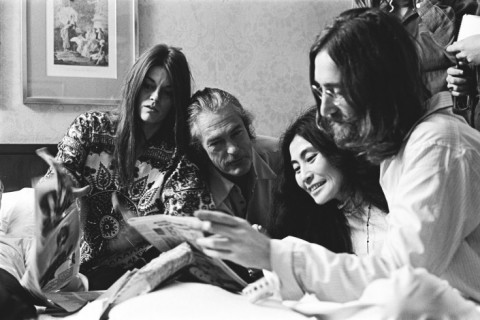
On May 26, 1969, John Lennon and Yoko One began their second “Bed-In,” a form of anti-Vietnam War protest that combined the media impact of a press conference with the comfort of hotel sheets.


Their first Bed-In, which happened in various rooms of the Amsterdam Hilton in late March of that year, saw them grant interview after interview about peace all day long without moving from the bed in which they had ensconced themselves.

They’d scheduled its follow up in New York City, but Lennon found he couldn’t enter the United States due to a previous conviction for marijuana possession.

They relocated it to the Bahamas, where the heat soon prompted them to move again to the entirely cooler Queen Elizabeth Hotel in Montreal.

There they recorded the song “Give Peace a Chance,” aided by such visitors as Tommy Smothers, Dick Gregory, Murray the K, and psychedelic drug advocate Timothy Leary.

But Leary didn’t just come to provide a backing vocal. With his wife Rosemary, he recorded a conversation with Lennon and Ono about … well, about a variety of subjects, but they’d all fall under the broad heading of Leary’s one great pursuit, “consciousness.”

Only recently did Leary archivist Michael Horowitz discover the transcript of this session in “an unmarked envelope in a box of miscellaneous papers,” and this week the Timothy Leary Archives made it available to the public for the first time ever.

The conversation begins with the finer points of teepee life, moves on to the effects of place on one’s state of mind, touches on both couples’ having found themselves on the wrong side of drug law enforcement, and ends with Lennon and Leary comparing notes on how they use the media to convey their message:
TIMOTHY: John, about the use of the mass media ... the kids must be taught how to use the media. People used to say to me - I would give a rap and someone would get up and say, “Well, what’s this about a religion? Did the Buddha use drugs? Did the Buddha go on television? I’d say, “Ahh - he would’ve. He would’ve …”.
JOHN: I was on a TV show with David Frost and Yehudi Menuhin, some cultural violinist y’know, they were really attacking me. They had a whole audience and everything. It was after we got back from Amsterdam … and Yehudi Menuhin came out, he’s always doing these Hindu numbers. All that pious bit, and his school for violinists, and all that. And Yehudi Menuhi said, “Well, don’t you think it’s necessary to kill some people some times?” That’s what he said on TV, that’s the first thing he’s ever said. And I said, “Did Christ say that? Are you a Christian?” “Yeah,” I said, and did “Christ say anything about killing people?” And he said, “Did Christ say anything about television? Or guitars?”
To learn more about Lennon and Ono’s Bed-Ins, you can visit the 70-minute documentary Bed Peace (below), previously featured on Open Culture and still freely viewable on YouTube:

Tuesday, November 5, 2013

VIDEO: Deconstructing The Master Track of The Beatles’ “Sgt. Pepper’s Lonely Hearts Club Band”

by , Open Culture: http://www.openculture.com/2013/07/deconstructing_the_sgt_peppers_lonely_hearts_club_band_.html

Josh Jones is a writer and musician based in Washington, DC. Follow him at @jdmagness


There are several versions of the story of how The Beatles’ most highly-acclaimed album Sgt. Pepper’s Lonely Hearts Club came to be.

In one, John gives the full credit to Paul, who, inspired by “America and the whole West Coast, long-named group thing” - of bands like Quicksilver Messenger Service and Big Brother and the Holding Company - came up with the concept.

According to Lennon, Paul “was trying to put some distance between the Beatles and the public”:

"And so there was this identity of Sgt. Pepper … Sgt. Pepper is called the first concept album, but it doesn’t go anywhere. All my contributions to the album have absolutely nothing to do with the idea of Sgt. Pepper and his band; but it works ‘cause we said it worked, and that’s how the album appeared. But it was not as put together as it sounds, except for Sgt. Pepper introducing Billy Shears and the so-called reprise. Every other song could have been on any other album".

Lennon’s typical mix of grandiosity and self-deprecation probably sells the album short in any fan’s estimation (certainly in mine), but I  believe that Paul cooked up the goofy personas and marching-band look. It is, after all, as Lennon says, “his way of working.”

Paul himself has said of Sgt. Pepper’s: “I thought it would be nice to lose our identities, to submerge ourselves in the persona of a fake group. We could make up all the culture around it and collect all our heroes in one place.”

Despite the complex of personalities (both real and imagined) in the writing and recording of what many consider the band’s masterpiece, the recording process was incredibly simple, at least by today’s standards.

Today’s digital recording enables bands to record an unlimited number of tracks - either live or, more often, in layers upon layers of overdubs - leaving mixing engineers with sometimes hundreds of individual tracks to integrate into a coherent whole.

In 1967, during the age of tape and the tracking of Sgt. Pepper’s, engineers were limited to four tracks at a time, which they could then “bounce,” or merge together, to free up room for additional recording.

This is how the title song “Sgt. Pepper’s Lonely Heart’s Club Band” was made, and you can hear the four final master tracks “deconstructed” above.

First, in green, you’ll hear the original rhythm tracks, with drums, bass, and two guitars, all recorded on two tracks.

The red line represents tracks 3 and 4 - all of the vocals.

The blue portion is the horns and lead guitar, and yellow is the audience sounds.

You’ll hear each track individually, then hear them all come together, so to speak. The description below of the recording process comes from that inerrant (so I’ve heard) source, The Beatles Bible:

"The song was recorded over four days. On 1 February 1967 The Beatles taped nine takes of the rhythm track, though only the first and last of these were complete. They recorded drums, bass and two guitars - the latter played by McCartney and Harrison. The next day McCartney recorded his lead vocals, and he, Lennon and Harrison taped their harmonies. The song was then left for over a month, until the French horns were overdubbed on 3 March. McCartney also recorded a lead guitar solo, leaving the song almost complete. On 6 March they added the sounds of the imaginary audience and the noise of an orchestra tuning up, a combination of crowd noise from a 1961 recording of the comedy show Beyond The Fringe and out-takes from the 10 February orchestral overdub session for A Day In The Life. For the segue into With A Little Help From My Friends, meanwhile, they inserted screams of Beatlemaniacs from the recordings of The Beatles live at the Hollywood Bowl".

Tuesday, October 22, 2013

VIDEO: "Working Class Hero" by John Lennon

by jigowatts


As soon as you're born they make you feel small
By giving you no time instead of it all
Till the pain is so big you feel nothing at all

A working class hero is something to be

They hurt you at home and they hit you at school
They hate you if you're clever and they despise a fool
Till you're so fucking crazy you can't follow their rules

A working class hero is something to be

When they've tortured and scared you for twenty odd years
Then they expect you to pick a career
When you can't really function you're so full of fear

A working class hero is something to be

Keep you doped with religion and sex and TV
And you think you're so clever and class less and free
But you're still fucking peasants as far as I can see

A working class hero is something to be

There's room at the top they are telling you still
But first you must learn how to smile as you kill
If you want to be like the folks on the hill

A working class hero is something to be

If you want to be a hero well just follow me

Friday, August 30, 2013

VIDEO: John Lennon’s Raw, Soul-Baring Vocals From the Beatles’ ‘Don’t Let Me Down’ (1969)

by , Open Culture: http://www.openculture.com/2013/08/john-lennons-vocals-from-the-beatles-dont-let-me-down.html


“When you’re drowning,” John Lennon told Rolling Stone in 1970, “you don’t say, ‘I would be incredibly pleased if someone would have the foresight to notice me drowning and come and help me.’ You just scream.”

“Don’t Let Me Down” is Lennon’s anguished scream to his lover, Yoko Ono. When he and the Beatles recorded the song during the Let It Be sessions in late January of 1969, Lennon asked Ringo Starr to hit the cymbal very hard at the beginning, to “give me the courage to come screaming in.”

The Beatles were in the process of breaking apart when Lennon wrote the song. It was a dark time in many ways, and he was becoming more and more dependent upon Ono for personal and creative support.

As Paul McCartney told writer Barry Miles in Many Years From Now:

It was a very tense period: John was with Yoko and had escalated to heroin and all the accompanying paranoias and he was putting himself out on a limb. I think that as much as it excited and amused him, at the same time it secretly terrified him. So ‘Don’t Let Me Down’ was a genuine plea, ‘Don’t let me down, please, whatever you do. I’m out on this limb, I know I’m doing all this stuff, just don’t let me down.’ It was saying to Yoko, ‘I’m really stepping out of line on this one. I’m really letting my vulnerability be seen, so you must not let me down.’ I think it was a genuine cry for help.

You can get a strong sense of Lennon’s anguish and vulnerability when you listen to the isolated vocal track above. And for the full arrangement, including Starr’s cymbal-crash near the beginning and Billy Preston’s brilliant electric piano playing, see below.


Thursday, August 22, 2013

The Beatles’ Final, “Painful” Photo Shoot: A Gallery of Bittersweet Images

by , Open Culture: http://www.openculture.com/2013/08/the-beatles-final-painful-photo-shoot-a-gallery-of-bittersweet-images.html

lastBeatlesShoot

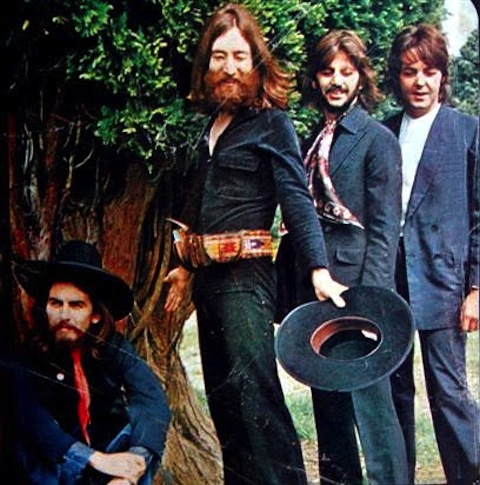
Well, this is bittersweet. The photo above comes from The Beatles’ final photo shoot together at John Lennon’s newly purchased estate in Sunninghill Berkshire: clearly not a welcome event for at least one Beatle.

The band had just completed their final two album releases, Let it Be and Abbey Road - famously contentious recording sessions in which George Harrison walked out for a few days with a flippant “See you ‘round the clubs,” prompting John Lennon to snap (according to director Michael Lindsay-Hogg), “Let’s get in Eric [Clapton]. He’s just as good and not such a headache.”

George later recalled the circumstances of the shoot:

They were filming us having a row. It never came to blows, but I thought, ‘What’s the point of this? I’m quite capable of being relatively happy on my own and I’m not able to be happy in this situation. I’m getting out of here.’ Everybody had gone through that. Ringo had left at one point. I know John wanted out. It was a very, very difficult, stressful time, and being filmed having a row as well was terrible. I got up and I thought, ‘I’m not doing this any more. I’m out of here.’ So I got my guitar and went home and that afternoon wrote Wah-Wah. It became stifling, so that although this new album was supposed to break away from that type of recording (we were going back to playing live) it was still very much that kind of situation where he already had in his mind what he wanted. Paul wanted nobody to play on his songs until he decided how it should go. For me it was like: ‘What am I doing here? This is painful!’

See many more photos from the shoot and read more painful details about the sessions and, yes, Yoko, over at Messy Nessy Chic.

via Mefi.

Thursday, July 11, 2013

The Best John Lennon Songs That Never Made The Charts, Part 3

by Garrett Sawyer

John Lennon's death at the tender age of 40 cut short what was easily one of the greatest careers of the rock era. Here are some of the best John Lennon songs that never made it to the Billboard top 40, from "Walls and Bridges" and "Double Fantasy"

1) "Steel and Glass"

If "How Do You Sleep?" was a musical dart thrown at McCartney "Steel and Glass" was the next one, this one thrown at Allen Klein. For years Klein had taken over the management responsibilities of the Beatles at Apple Corps until their 1970 breakup.

He had also helped George Harrison organize the Concert for Bangladesh. Unfortunately, Klein made the mistake of siding with Harrison, who believed that Yoko shouldn't perform and that Lennon should perform without her.

By 1974 their relationship had soured enough that Lennon believed Klein had turned against him and penned this song as a result.

When Lennon sang, "Your mother left you when you were small, but you're gonna wish you were never born at all." he was factually accurate (Klein's mother died before his first birthday) but a bit over the top, even if true.

2) "I'm Losing You"

We've all had it happen that we're trying to reach somebody on the phone but can't. It happened to Lennon when he was in Bermuda and tried to call Yoko. Just like the rest of us he got annoyed. Only Lennon, however, can turn it into a terrific song while the rest of us just stew in our juices.

But it's pertinent that the incident was also metaphorical for many of the troubles he'd had with Yoko previously, specifically his "lost weekend" separation from her that lasted eighteen months. It referred to other losses, too, such as the loss of his mother.

And when he belts out, "I remind you of all that bad stuff, So what the hell am I supposed to do? Just put a bandaid on it?" his delivery is absolutely perfect.

3) "Beautiful Boy"

You couldn't ask for a more exquisite lullaby than this, complete with a tropical arrangement. Yet even in this tribute to his son, Sean, Lennon has a pun or two up his sleeve.

When he sings "Every day, in every way, it's getting better and better" he's harkening back to Sergeant Pepper's Lonely Hearts Club Band and the song "Getting Better".

Lennon's contribution to the earlier song was a tart comical "it can't get no worse" but here he's sincere, not a trace of sarcasm in sight.

The line also refers to French psychologist Emile Coue, who instructed his patients to repeat this statement regularly as a mantra for therapeutic reasons. (Sample lyric: "Life is what happens to you while you're busy making other plans.")

I hope you enjoyed this retrospective of John Lennon's solo work. If you're anything like me it must break your heart to think of what Lennon would have been able to create had he lived the normal, healthy life span he so richly deserved.

If you like John Lennon's songs then you'll like a song inspired by the story of a young soldier who returned from Iraq. For a limited time only you can download that song for FREE by clicking HERE.

Download your free mp3 at: http://www.garrettsawyer.net/am/

Article Source: http://EzineArticles.com/?expert=Garrett_Sawyer
http://EzineArticles.com/?The-Best-John-Lennon-Songs-That-Never-Made-The-Charts,-Part-3&id=7848232

Wednesday, July 10, 2013

The Best John Lennon Songs That Never Made The Charts, Part 2

by Garrett Sawyer

John Lennon's first two solo albums were back-to-back masterpieces: "Plastic Ono Band" and "Imagine". Here are more of the best John Lennon songs that didn't make it to the Billboard top 40:

1) "God"

This song was a composite. Lennon told Rolling Stone how he put it together "from three songs, almost". Musically it was arranged like "Mother", except with Billy Preston added on piano.

He starts by expressing his view of God as a measurement of pain, explaining to Rolling Stone that when he wrote the line he felt like he had been crucified, "So, I know what they're talking about now."

The second part rolls into a litany of people and things that Lennon didn't believe in. When he wrote the song the first few just rolled out.

He later joked that it had become like a shopping list, even considering adding a line with a blank so that the listener could fill in whoever they didn't believe in.

He finally ended with "Beatles", as if we needed to be reminded of the finality with which the Beatles had broken up. (Sample Lyric: "The dream is over. What can I say?").

2) "Gimme Some Truth"

Here's John Lennon's catalogue of disasters. In verse after verse he lists all of the people he can't stand, slaps them all around a lot and ends each entry with "All I want is the truth. Just gimme some truth."

Among the targets of Lennon's acid pen were hypocrites, politicians, chauvinists, and primma donnas all lovingly blasted to bits. In the refrain he takes aim directly at Richard Nixon, whose "tricky dicky" nickname had been a standard for years.

Unnamed in the song (but one of its biggest inspirations) was Lennon's frustration with the cover-up of the My Lai massacre. Thus, when he demands the truth you know what he's talking about.

This was another quasi-Beatle effort, with George Harrison playing lead electric guitar. (Sample Lyric: "I'm sick to death of seeing things from tight-lipped, condescending, mamas little chauvinists").

3) "How Do You Sleep?"

The good news for Paul McCartney was that he wasn't featured in "Gimme Some Truth". The bad news is that he was featured in this one. When McCartney released "Ram" the leadoff song "Too Many People" took a couple of swipes at Lennon. Lennon promptly returned the favor.

The innumerable references and put downs are unmistakable. Lennon even started the song with a low cacophony of voices similar to those found at the beginning of Sgt. Pepper's Lonely Hearts Club Band and begins singing the words "So Sgt. Pepper took you by surprise ... ".

Again, George Harrison played lead slide guitar. We can only speculate how much pleasure he took in doing so. (Sample Lyric: "The sound you make is muzak to my ears. You must have learned something in all those years").

In my final segment I'll finish with more of the best John Lennon songs from the last part of his solo career that never made it to the charts.

If you like John Lennon's songs then you'll like a song inspired by the story of a young soldier who returned from Iraq. For a limited time only you can download that song for FREE by clicking HERE.

Download your free mp3 at: http://www.garrettsawyer.net/am/

Article Source: http://EzineArticles.com/?expert=Garrett_Sawyer
http://EzineArticles.com/?The-Best-John-Lennon-Songs-That-Never-Made-The-Charts,-Part-2&id=7848206

Tuesday, July 9, 2013

The Best John Lennon Songs That Never Made The Charts, Part 1

by Garrett Sawyer

John Lennon wasn't just a prominent figure in the world of rock and roll. He was rock and roll. Only Elvis could be said to be more dominant than the Beatles.

As a solo artist Lennon was unique, producing a string of chart hits. But even some of his lesser songs are powerful and memorable.

Here's my personal version of the best John Lennon songs from the early part of his solo career that never made it to Billboard's top 40.

1) "Mother"

This was the leadoff track from his first true solo album "Plastic Ono Band" and the song that he intended to be a single (it never made it).

He and Yoko were undergoing Primal Scream with Dr. Arthur Janov at the time; Lennon was dealing with the breakup of the Beatles and the death of his mother, who was run over by an off-duty police officer named Eric Clague when he was only 17.

Lennon started the song with a church bell which he had slowed down in order to make it sound more ominous. The instrumentation was simple and sparse: Lennon on piano, Klaus Voorman on Bass and Ringo on drums.

Lennon simply played the chords, letting the harmonics of the piano notes do the rest to fill the spaces in the measures.

The lyrics are raw: personal loss at full volume, his mother to death and his father to work (he was a seaman). In the end he repeats over and over again "Mama, don't go! Daddy, come home!" rising with each repetition to a childlike scream.

Lennon added the screams after the rest of the vocals were finished. He kept trying this night after night. The results were double-tracked, reverbed and echoed to achieve the final shattering result (Sample Lyric: "Children, don't do what I have done. I couldn't walk so I tried to run").

2) "Working Class Hero"

This song was a bit of a misnomer because Lennon, for whatever personal heartaches he suffered, was actually raised middle class. You'd never know that from listening to this song, however, because he nails it perfectly.

This just goes to show you how far you can go with just your voice, a single acoustic guitar and a truckload of real talent. Lennon strums and sings a vivid picture of growing up scared, abused and confused.

As Lennon himself told Rolling Stone "I think it's for the people like me who are working class - whatever, upper or lower - who are supposed to be processed into the middle classes, through the machinery, that's all. It's my experience, and I hope it's just a warning to people" (Sample lyric: "As soon as you're born they make you feel small by giving you no time instead of it all").

In my next segment I'll continue with more of the best John Lennon songs from the early part of his solo career. If you haven't heard these by now you've got a treat in store.

If you like John Lennon's songs then you'll like a song inspired by the story of a young soldier who returned from Iraq. For a limited time only you can download that song for FREE by clicking HERE. Download your free song at: http://www.garrettsawyer.net/am/

Article Source: http://EzineArticles.com/?expert=Garrett_Sawyer
http://EzineArticles.com/?The-Best-John-Lennon-Songs-That-Never-Made-The-Charts,-Part-1&id=7841432

Friday, December 7, 2012

TRIBUTE: John Lennon: Watching The Wheels - Dec. 8: John Lennon Shot, Killed 1980

John Lennon
Cover of John Lennon
Hi all,

Dec. 8: John Lennon Shot, Killed 1980

1980 John Lennon Killed

The Beatles‘ musician John Lennon was shot and killed outside of his New York City apartment on the night of Dec. 8, 1980. Lennon and wife Yoko Ono were returning from the recording studio to their home at The Dakota when 25-year-old crazed fan Mark David Chapman shot him at close range.

Earlier in the day Chapman had been hanging around The Dakota with other fans and asked Lennon for an autograph.

When The Beatles broke up in 1970, John Lennon focused on humanitarian and social activism. After the 1975 birth of his son Sean, John Lennon retreated from public eye to concentrate on his family. John Lennon and Yoko Ono’s 1980 “Double-Fantasy” album was planned to be his comeback in the music scene. Lennon was murdered just weeks after “Double-Fantasy” was released.


Video uploaded to YouTube by gilmem

2000 Mark David Chapman Interview
 
Twenty years after Lennon’s death, Barbara Walters revisited her 1992 interview with Mark David Chapman. This was the killer’s first televised interview.

Chapman was sentenced to 20 years to life for killing Lennon and is serving his time at New York’s Attica Prison. He is one of the many infamous killers said to have carried a copy of J.D. Salinger’s “Catcher in the Rye” with him.

When Barbara Walters asked why he did it, Chapman replied with a straight face, “I thought by killing him, I would acquire his fame.”
Enhanced by Zemanta

Tuesday, November 13, 2012

VIDEO: God by John Lennon

Hi all,

Love this one by John Lennon!

From the creator of the video (henriquebissoli): An original video I created of John Lennon's song God from the Plastic Ono Band album. It features scenes from the movie "Imagine", footage shot the night he was killed, quotes, and photos from the internet.

Uploaded onto YouTube by henriquebissoli

Tuesday, August 21, 2012

NEWS: John Lennon ... Chapman Up for Parole Again

by Retro: Kimmer: http://www.retrokimmer.com/2012/08/john-lennonchapman-up-for-parole-again.html

I do not wish to promote MD Chapman in anyway but ... he is up for parole again ... truly I hope he stays put.

John Lennon's killer is up for parole this week for a seventh time and could have a hearing as early as Tuesday, officials said.


Mark David Chapman pleaded guilty to second-degree murder and was sentenced to 20 years to life for gunning down the Beatle outside of his Manhattan apartment complex on Dec. 8, 1980.

A decision regarding Chapman's release could come as soon as Thursday or Friday, according to the New York Department of Corrections.

At Chapman's last parole hearing in September 2010, he told the board there had been other names on his list of potential targets, including Johnny Carson, Elizabeth Taylor and two others he could not recall.

Yoko Ono, the wife of the late musician, said in 2010 that she opposed paroling Chapman and believed he could be a danger to her and her family. Chapman is currently being housed at the Wende Correctional Facility in Alden, N.Y.